 listicle
Essential Drone Hardware for Commercial Farming
Table of Contents
- Essential Drone Hardware for Commercial Farming Operations
- Agricultural Drone Equipment: Core Aircraft and Airframe
- Agricultural Drone Sensors and Imaging Capabilities
- Multispectral Drone for Crop Monitoring and Health Assessment
- Agricultural Drone Batteries and Charging Infrastructure
- Precision Spraying Systems and Payload Hardware
- Ground Support Equipment and Field Operations Setup
- Total Cost of Ownership and Maintenance Planning
- Frequently Asked Questions
Last Updated: October 15, 2026
Essential Drone Hardware for Commercial Farming Operations
Commercial farming operations rely on sophisticated drone hardware commercial farming to maximize crop yields, reduce input costs, and make data-driven decisions across hundreds or thousands of acres.
The right hardware setup transforms how you monitor crop health, detect disease early, apply inputs precisely, and track field conditions in real time.
Below, we'll walk through the core drone hardware commercial farming operations depend on: the aircraft and airframe, sensors and imaging, power systems, spraying equipment, and ground infrastructure.
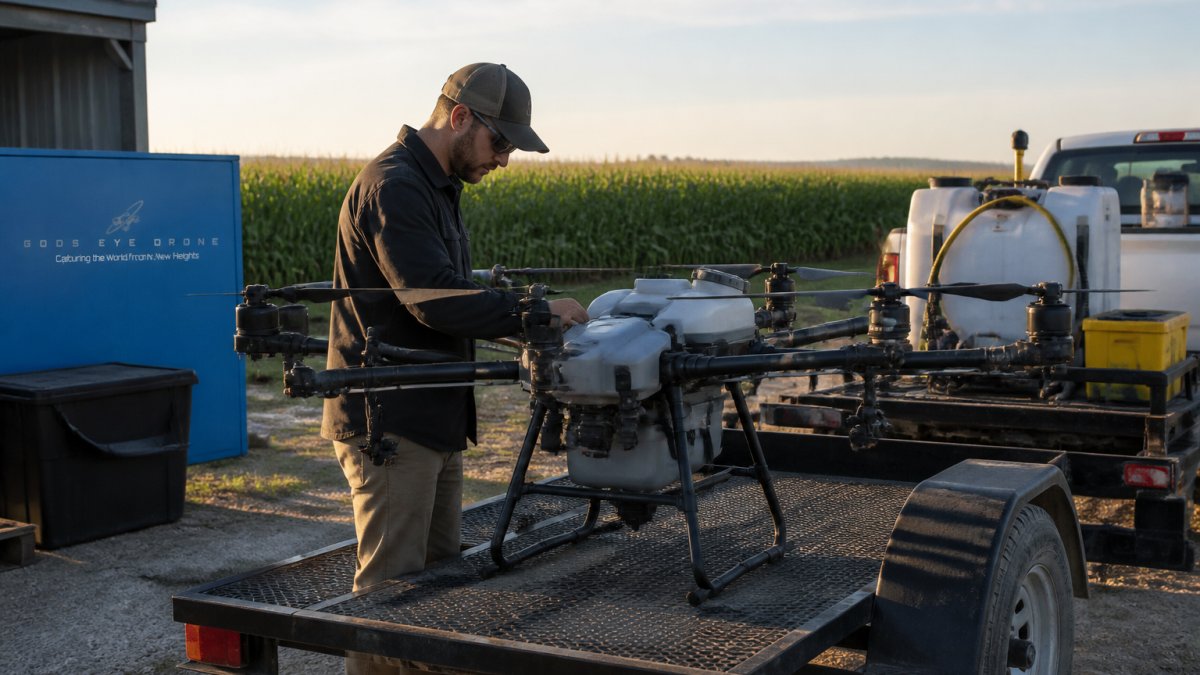
Agricultural Drone Equipment: Core Aircraft and Airframe
The aircraft platform forms the foundation of your operation. For commercial farming, you're choosing between multirotor designs (typically 4-8 rotors) and fixed-wing platforms, each with different payload capacities, flight times, and operational characteristics.
Spray Drone Models for Commercial Operations
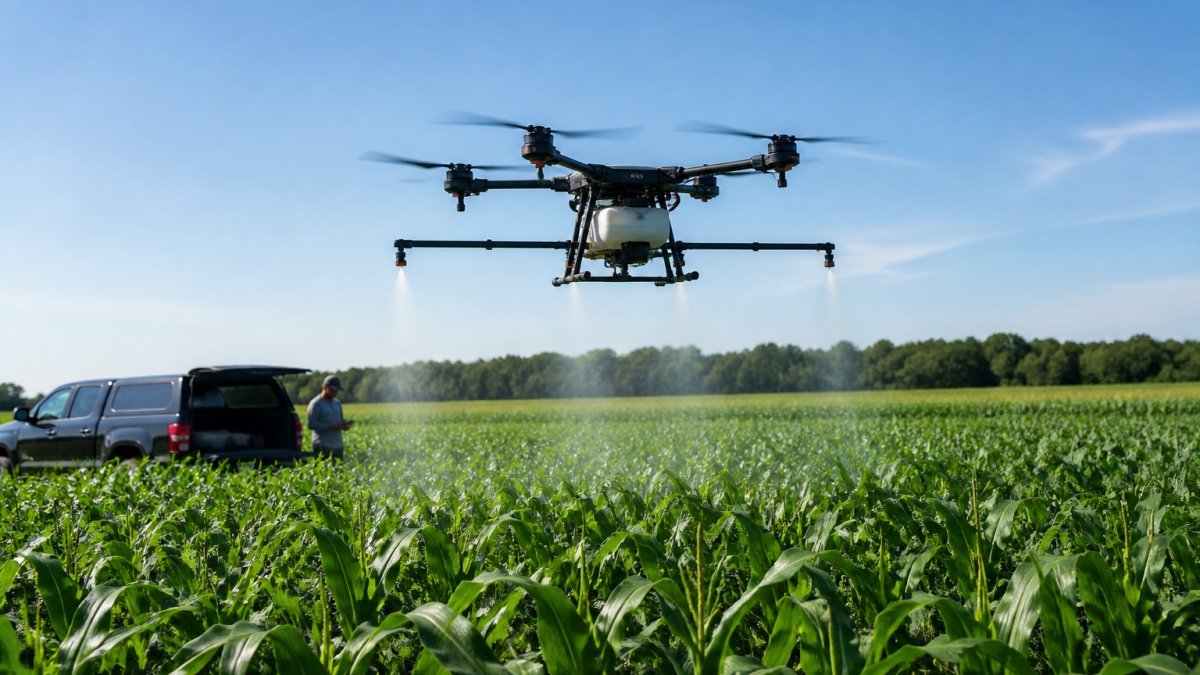
Spray-specific drones are purpose-built for agricultural application. The DJI Agras T50 is recognized as a leading option for commercial growers and custom applicators, designed specifically for crop-spraying workflows. The DJI Agras T100 also appears in comparisons of commercial spray-drone hardware.
Hylio agricultural spray drones and the XAG P150 Max represent additional options in the commercial spray-drone market. The Talos T60X and EA Vision agricultural drones round out the spray-drone category for operators researching commercial spraying platforms.
Each spray drone model differs in payload capacity, tank size, nozzle configuration, and flight endurance.
Flight Control and Navigation Systems
Flight control systems manage the drone's stability, autonomous navigation, and mission execution. Commercial farming drones rely on GPS positioning for precise field coverage, autonomous flight paths that follow field boundaries, and waypoint-based missions that repeat the same route across multiple flights.
A strong flight control system logs flight data, monitors battery voltage and motor performance in real time, and allows switching between manual and autonomous modes.
The navigation system also handles geofencing, preventing flight outside defined boundaries, and return-to-home functionality that brings the aircraft back to its launch point if signal is lost or battery reaches a critical threshold.
Agricultural Drone Sensors and Imaging Capabilities
Sensors transform your drone from a flying platform into a data-collection tool. The imaging hardware you carry determines what information you can extract about crop health, soil conditions, and field variability.
Multispectral and Thermal Imaging
Multispectral cameras capture data across multiple wavelengths, including visible red, green, blue, and near-infrared (NIR) bands, revealing crop health patterns invisible to the human eye. Normalized Difference Vegetation Index (NDVI) calculations derived from multispectral imagery quantify plant vigor and identify stress before symptoms appear visually (NDVI, the Foundation for Remote Sensing Phenology).
Thermal imaging captures infrared radiation, revealing temperature patterns across your field. Thermal data helps identify irrigation issues, disease hotspots, and crop stress, and is particularly valuable for detecting pest infestations and disease progression that correlate with temperature anomalies.
Both multispectral and thermal sensors require calibration, proper flight altitude for desired ground resolution, and post-flight processing to generate actionable maps. Sensor payload affects flight time and endurance, so balancing imaging capability with operational range is essential.
High-Resolution Cameras for Field Documentation
Standard RGB (red-green-blue) cameras at 20-45 megapixels provide visual documentation of field conditions. High-resolution imagery lets you identify specific problem areas, document pest damage, and create orthomosaics (stitched aerial images) showing your entire field in a single georeferenced photograph.
RGB cameras are lighter than multispectral or thermal sensors, allowing longer flight times and faster field coverage. They're valuable for visual scouting, before-and-after treatment records, and identifying infrastructure issues like irrigation leaks or equipment damage.
Multispectral Drone for Crop Monitoring and Health Assessment
A multispectral drone for crop monitoring becomes the centerpiece of precision agriculture workflows. Collecting consistent multispectral data at regular intervals throughout the growing season builds a time-series record of crop development and stress.
Remote Sensing and Crop Health Analysis
Remote sensing through multispectral imagery quantifies crop health across your entire field without setting foot in the crops. NDVI maps show relative plant vigor; lower NDVI indicates stress from disease, nutrient deficiency, moisture stress, or pest pressure. Comparing NDVI maps across flights tracks how conditions evolve and respond to management decisions.
The multispectral drone for crop monitoring also enables variable-rate management: applying more intensive treatment to stressed areas and lighter treatment to vigorous ones. This targeted approach reduces input costs and environmental impact while maximizing yield in marginal zones.
Disease Detection and Pest Management
Early disease detection is one of the highest-value applications of multispectral imaging. Many diseases alter the spectral signature of leaves before visual symptoms appear, so regular multispectral flights let you detect progression early, when intervention is most effective and least costly.
Pest pressure often correlates with crop stress patterns visible in multispectral data. Insect infestations, spider mites, and fungal diseases all leave spectral fingerprints that trained analysis can identify, letting you scout more efficiently and confirm pest presence before deploying control measures.
Agricultural Drone Batteries and Charging Infrastructure
Flight endurance depends entirely on battery capacity and power management. Commercial farming operations require reliable power infrastructure to keep drones operational throughout the day.
Battery Selection and Flight Endurance
Lithium polymer (LiPo) and lithium-ion batteries are standard in commercial agricultural drones. Battery capacity, measured in milliamp-hours (mAh) or watt-hours (Wh), determines flight time per charge. Larger batteries increase endurance but add weight, reducing payload capacity.
Most commercial spray drones achieve 15-25 minutes of flight time per battery, depending on payload weight, wind conditions, and flight speed. For efficient operations, run 2-4 batteries per drone so that while one charges, you're flying with another.
Battery lifespan degrades with charge cycles. A commercial battery typically retains 80% capacity after 300-500 charge cycles, equivalent to 1-2 years of regular use.
Charging Systems and Power Management
Charging infrastructure determines how quickly you can turn batteries around between flights. A standard charger might require 45-90 minutes to fully charge a battery.
A generator or mobile charging station eliminates dependence on grid power at remote field locations.
Proper battery storage and maintenance extend lifespan and prevent safety issues. Store batteries at moderate temperatures, keep them at partial charge during long storage, and monitor for swelling or damage.
Precision Spraying Systems and Payload Hardware
Spray-specific hardware transforms a drone into a precision application tool. The tank, pump, nozzles, and flow-control system work together to deliver consistent coverage and accurate application rates.
Tank Capacity and Spray Nozzle Configuration
Tank capacity ranges from 2.2 gallons on smaller multirotors to 5-10 gallons on dedicated spray drones. Larger tanks reduce refill cycles and improve efficiency, but add weight, reducing flight time and payload capacity for additional sensors.
Spray nozzles determine droplet size, coverage pattern, and application rate. Coarser droplets drift less in wind and penetrate dense canopy better; finer droplets give more complete leaf-surface coverage.
High-pressure nozzle systems (typically 40-80 PSI) deliver more consistent droplet size and coverage than low-pressure systems. The pump, driven by the drone's battery or a separate motor, maintains pressure throughout application, while flow-control valves adjust application rate without changing flight speed.
Targeted Application and Coverage Rate
Precision spraying reduces input costs by applying only what's needed, where it's needed. Variable-rate spraying, controlled by flight-path data and real-time field conditions, applies higher volumes to problem areas and lower volumes to healthy ones, reducing chemical use and environmental impact.
Coverage rate, measured in acres per hour, depends on tank capacity, flight speed, and swath width.
Application accuracy depends on flight stability, wind conditions, and nozzle performance. Consistent altitude and speed ensure uniform coverage, and flying in calm conditions (early morning or evening) reduces drift and improves targeting accuracy.
Ground Support Equipment and Field Operations Setup
The drone itself is only part of the system. Supporting equipment handles power, data management, and field logistics.
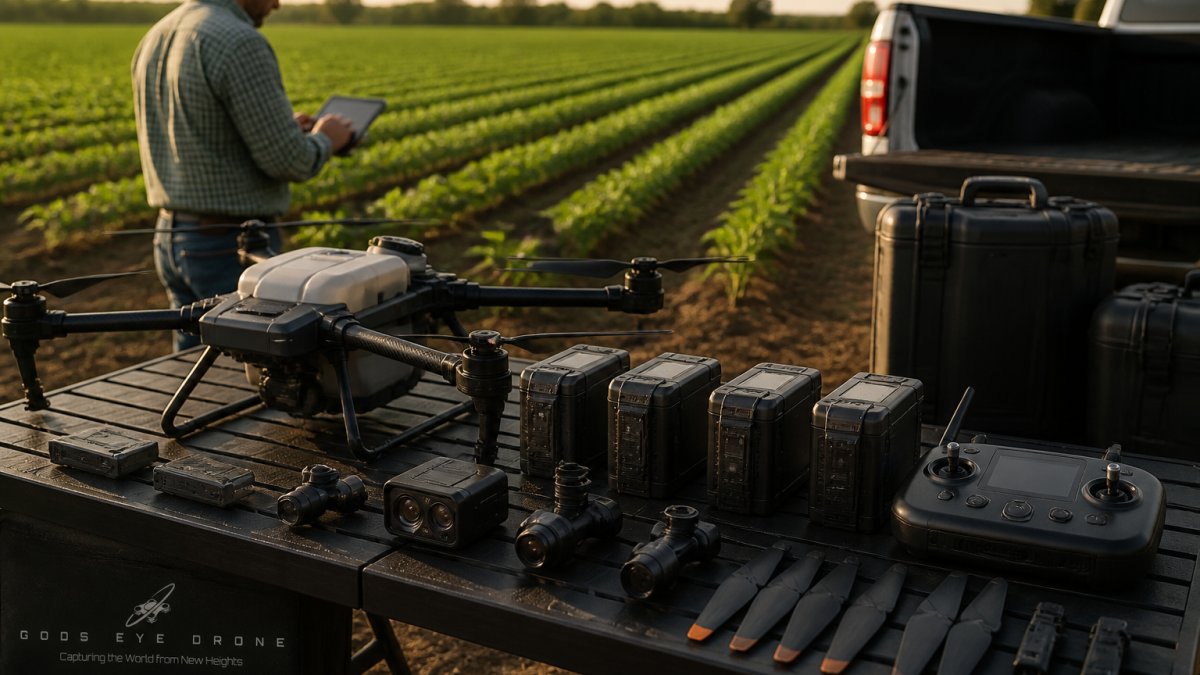
Generators, Chargers, and Mobile Stations
A portable generator or battery-powered charging station keeps your operation mobile. Generators rated for 3-5 kilowatts provide sufficient power for multiple battery chargers and laptops for mission planning and data review.
A mobile operations trailer consolidates charging equipment, spare parts, tools, and weather monitoring instruments, letting your team work from the field and reducing travel time between launch site and charging infrastructure.
Spare propellers, motors, and electronic speed controllers should be stocked on-site. These components wear with use and occasional failures require quick replacement to minimize downtime. A simple maintenance kit, screwdrivers, propeller balancer, spare batteries, and replacement fasteners, keeps your equipment operational.
Data Analytics and Field Integration
Raw drone imagery requires processing and analysis to become actionable intelligence. Specialized software processes multispectral data into NDVI maps, thermal data into temperature profiles, and RGB imagery into orthomosaics.
Integration with farm management software allows drone data to flow directly into your existing decision-making systems. GPS-tagged imagery georferences every observation to a specific field location, enabling variable-rate management and precise documentation of treatment areas.
Data storage and security matter at scale. A single multispectral flight across 500 acres generates gigabytes of imagery. Reliable backup systems, cloud storage integration, and data security protocols protect your operational history and prevent loss of critical field records.
| Component | Purpose | Typical Lifespan | Replacement Frequency |
|---|---|---|---|
| Aircraft frame | Primary structure | 2-3 years | As needed after damage |
| Battery pack | Power source | 300-500 cycles | Every 1-2 years |
| Propeller | Thrust generation | 50-100 flight hours | Every 3-6 months |
| Motor | Rotor drive | 500+ flight hours | Every 2-3 years |
| Imaging sensor | Data collection | 3-5 years | As technology improves |
| GPS/RTK module | Navigation | 3-5 years | As needed |
| Spray nozzle | Application | 50-100 flight hours | Every 3-6 months |
Total Cost of Ownership and Maintenance Planning
Purchasing a drone is the beginning, not the end, of your investment. Total cost of ownership includes the aircraft, sensors, batteries, spare parts, maintenance, training, and software subscriptions.
Battery replacement is your largest recurring cost.
Software subscriptions for data processing, field mapping, and farm management integration add annual costs.
Pilot training and certification ensure safe, legal operations. Certified commercial pilots understand airspace regulations, weather safety, and equipment limitations.
Maintenance planning extends component lifespan. Regular motor inspections, propeller balancing, and GPS calibration prevent failures. Keeping detailed flight logs helps identify wear patterns and schedule preventive maintenance before components fail.
Building a commercial farming operation around drone hardware requires planning across aircraft selection, sensor capability, power infrastructure, and ground support. Gods Eye Drone brings certified expertise and state-of-the-art technology to help you integrate drone hardware into your operation effectively. Book Now to discuss your specific needs and see how aerial intelligence can improve your farm's profitability and sustainability.
Frequently Asked Questions
What hardware do you need for a commercial agricultural drone?
A complete commercial agricultural drone setup includes the aircraft itself, multispectral or thermal sensors for crop monitoring, a spray system with tank and nozzles, batteries and chargers, GPS navigation, flight control systems, and ground support equipment like generators and mobile charging stations. You'll also need data analytics software to process field imagery and soil analysis data. The specific hardware depends on whether you're focused on crop monitoring, precision spraying, or both.
What sensors are used in agricultural drones?
Agricultural drone sensors include multispectral cameras that capture plant health data across multiple wavelengths, thermal imaging for irrigation analysis and pest detection, and high-resolution RGB cameras for visual field documentation. Multispectral drones measure vegetation indices that reveal crop stress, disease, and nutrient deficiencies before visible symptoms appear. Thermal sensors detect temperature variations useful for irrigation planning and identifying problem areas.
How many batteries does a commercial farm drone need?
Most commercial operations keep 3-6 batteries on hand to maintain continuous field operations. With flight endurance typically 20-40 minutes per battery depending on payload and conditions, multiple batteries allow operators to swap them during charging cycles. A complete charging infrastructure with fast chargers and backup power sources like generators ensures you can rotate batteries efficiently throughout the workday without interrupting field operations.
What is the difference between a mapping drone and a spraying drone?
Mapping drones prioritize sensor payload and flight endurance for crop monitoring, carrying multispectral or thermal cameras to collect field data. Spraying drones optimize for payload capacity and coverage rate, carrying large liquid tanks and precision nozzles for targeted application of pesticides or fertilizers. Some modern agricultural drones combine both capabilities, but pure spraying models sacrifice some flight time for larger tank capacity, while mapping drones carry lighter payloads for longer observation flights.