 listicle
7 Benefits of Drone Video for Luxury Real Estate
Table of Contents
- Why Drone Video Is Non-Negotiable for Luxury Listings
- 1. Showcase the Entire Estate and Property Boundaries
- 2. Elevate Property Presentation With Cinematic Footage
- 3. Highlight Outdoor Amenities and Landscape Architecture
- 4. Differentiate Listings in Competitive Luxury Markets
- 5. Provide Contextual Insights and Neighborhood Views
- 6. Complement Virtual Tours and Boost Engagement
- 7. Improve ROI and Speed Up Sales
- Choosing the Right Approach for Your Listings
- Frequently Asked Questions
Last Updated: September 9, 2026
Luxury real estate is sold on emotion, and no tool captures that emotion quite like an aerial perspective. For high-net-worth buyers, the decision often hinges on the full scope of the property: the land, the privacy, the lifestyle. Drone video delivers this narrative in a way that static ground-level photography simply cannot. At Gods Eye Drone, our certified pilots produce aerial footage that transforms property listings into cinematic experiences. This guide breaks down the seven most impactful benefits of drone video for luxury real estate and how to apply them to your listings.
Why Drone Video Is Non-Negotiable for Luxury Listings
The luxury market is a visual storytelling arena where curb appeal extends far beyond the front door. A bird's-eye view is the only way to convey the true scale of an estate, its relationship to the surrounding landscape, and the privacy that high-net-worth buyers demand. Without it, you are asking buyers to imagine the most compelling parts of the property, a risky proposition when dozens of other listings compete for their attention.
Listings featuring aerial imaging can generate higher engagement and faster sales velocity than those relying on ground-level photos alone (peer-reviewed research). A strategic drone video is no longer a differentiator; it is an expectation.
1. Showcase the Entire Estate and Property Boundaries
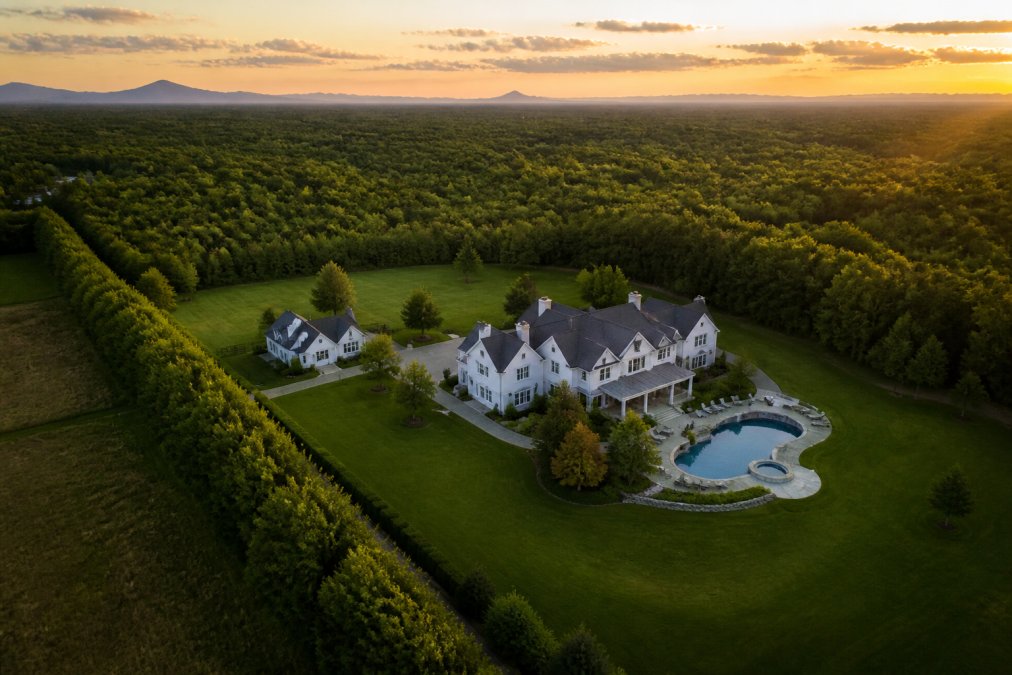
Drone video is the most effective way to capture the complete property estate, from the main residence to guest houses, pool complexes, and outbuildings. A single sweeping shot establishes property boundaries and total acreage naturally and impressively, critical for luxury buyers purchasing land and privacy as much as a home.
Wide-angle shots from altitude reveal how structures sit within the landscape, how hardscaping flows between buildings, and where the property line meets neighboring land. This clarity helps serious buyers pre-qualify a property before scheduling a showing, saving time for both agent and client.
2. Elevate Property Presentation With Cinematic Footage
A luxury listing deserves more than a slideshow of photographs. Cinematic footage, smooth, gimbal-stabilized, in 4K, creates an emotional connection still images cannot replicate, making the viewer feel as though they are gliding over the property on a private helicopter tour.
Professional pilots use slow reveals, strategic fly-bys, and altitude changes to build anticipation and highlight architectural features. The result is marketing collateral that elevates the entire presentation, making the listing feel as premium as the price tag.
3. Highlight Outdoor Amenities and Landscape Architecture
For luxury estates, outdoor living spaces are often the primary selling point. Drone video excels at showcasing landscape architecture, from garden designs and water features to tennis courts, putting greens, and resort-style pools, revealing the symmetry and intention of the landscaping in a single frame.
A dynamic flight path can seamlessly transition from the pool terrace to the interior courtyard, showing buyers how they would actually live in the space, turning a list of features into a tangible lifestyle vision.
4. Differentiate Listings in Competitive Luxury Markets
Standing out in a competitive luxury market requires more than a good photographer. Drone video offers a distinct advantage by providing a fresh, dramatic perspective that interrupts the scroll on listing portals and social media, signaling a higher level of professionalism and investment.
A listing that opens with an aerial sweep is more likely to be clicked, watched, and shared than one that begins with a standard front-door photo. Elevating perceived value from the first frame attracts more qualified buyers and strengthens the seller's negotiating position.
5. Provide Contextual Insights and Neighborhood Views
While the estate is the star, its setting is a critical supporting character. Drone video provides invaluable context by showing proximity to golf courses, waterfronts, equestrian trails, or a vibrant downtown, particularly effective for relocating buyers unfamiliar with the area.
A well-crafted aerial video tells the neighborhood's story without leaving the property, showing tree-lined streets, spacing between homes, and access to major thoroughfares, justifying value through both privacy and convenience.
6. Complement Virtual Tours and Boost Engagement
Drone video is not a replacement for a virtual walkthrough; it is the powerful opening act that drives viewers into the interior tour. A cinematic aerial sequence creates desire, compelling clicks into the interior, pairing aerial imaging with 3D walkthroughs creates a complete, immersive experience that keeps buyers engaged longer.
Video content inherently generates higher interaction on social media and listing sites. Pairing aerial video with a detailed virtual tour answers most buyer questions upfront, leading to more qualified showing requests.
7. Improve ROI and Speed Up Sales
For luxury real estate, the benefits of drone video can translate into improved ROI by potentially reducing time on market. A property that generates immediate, high-quality interest may be less likely to require price reductions, which can protect the seller's equity and the agent's reputation.
Budgeting for aerial imaging must be weighed against the cost of a stale listing. The collateral is highly reusable across your digital marketing strategy, from launch to email campaigns and social ads. A faster sale at asking price far outweighs the initial investment.
The Data-Backed Case for Aerial Marketing ROI
The carrying costs for a high-end property, mortgage, insurance, HOA fees, and maintenance, can easily run into tens of thousands of dollars per month. An aerial production that helps a property sell even two weeks faster can be a net positive for the seller's bottom line.
Successful luxury agents treat the aerial shoot as a pricing leverage tool. Listings that launch with cinematic footage can be positioned at a higher asking price from day one, because the visual presentation can justify the premium. This "launch high, hold firm" strategy can be viable when the collateral supports the price point.
Measuring the Impact on Your Listing Metrics
To truly understand ROI, track the most relevant data points for a luxury listing:
- Time-on-market (TOM): Compare the average TOM for your listings with drone video versus those without. A reduction in time on market can represent a significant financial win.
- Qualified showing requests: Track the number of showing requests that come directly from the video content. A higher ratio of qualified inquiries indicates that the video is pre-filtering buyers who are serious about the property.
- Listing page engagement: Monitor the average watch time on your video and the click-through rate to the interior tour. A high completion rate on a 60-90 second aerial film signals strong buyer intent.
- Price retention: Track the final sale price versus the original asking price. Listings that sell at or above asking are often those that generated the most competitive interest early on.
The Reusability Factor: One Shoot, Many Assets
A professional drone shoot is not a one-use asset. Repurpose the footage across your entire marketing stack:
- The main listing video for the MLS and your website.
- Short-form vertical cuts for Instagram Reels and TikTok, optimized for mobile viewing.
- A cinematic opener for your YouTube virtual tour.
- Email marketing headers for your exclusive buyer list.
- Social proof clips for your own agent brand, showing that you market properties at a higher standard.
This reusability drops the effective cost per use dramatically with each platform. An agent using the same footage across five channels gets significantly more value than one who only posts it to the MLS.
The Cost of Not Using Drone Video
The inverse of ROI is the cost of inaction. Buyers' agents often use marketing quality as a proxy for property quality and seller seriousness. A listing that looks amateurish invites lowball offers and extended negotiations, a far greater financial risk than the upfront cost of professional aerial imaging.
Choosing the Right Approach for Your Listings
The benefits of drone video for luxury real estate are clear, but execution matters. The ideal listing video length is 60 to 90 seconds. Best practices emphasize smooth, stabilized footage, professional color grading, and a narrative arc from wide estate view to specific details.
Real estate drone photography pricing varies by property size, location, and shoot complexity. The value lies in the quality of the final product and the pilot's expertise. A certified professional with state-of-the-art equipment can deliver footage that meets luxury market standards.
The Legal Foundation: FAA Part 107 Compliance
Before any drone flies over a luxury estate, the pilot must hold a Remote Pilot Certificate under FAA Part 107 rules (faa.gov). This is not optional. Operating a drone for commercial purposes, including creating marketing content for a property you intend to sell, requires this certification. Hiring an uncertified operator risks FAA fines.
Beyond basic certification, a professional pilot will also be aware of:
- Airspace restrictions: Many luxury properties are located near private airstrips, helipads, or controlled airspace. A Part 107 pilot must check the FAA's LAANC (Low Altitude Authorization and Notification Capability) system before every flight to ensure the airspace is clear (faa.gov).
- Privacy considerations: While the FAA governs the airspace, state and local privacy laws govern what you can record. A professional pilot will avoid flying over neighboring properties without permission and will be mindful of capturing images of people in adjacent yards or through windows. For gated communities, you may need written permission from the HOA before flying.
- Insurance requirements: A reputable drone service should carry liability insurance. Ask for proof of coverage before booking. This protects you and your seller in the unlikely event of an accident or property damage.
Technical Specifications for Luxury-Grade Footage
Not all drone footage is created equal. The difference between generic aerial video and cinematic luxury presentation comes down to technical execution. When vetting a drone service, ask about equipment and settings:
- Resolution: 4K is the industry standard for real estate, but for luxury listings, 5.4K or 6K capture provides extra headroom for cropping and stabilization in post-production without losing detail. This is critical when you want to create both a wide cinematic film and a vertical crop for social media from the same footage.
- Frame rate: Look for footage shot at 24 frames per second (fps) for that true cinematic look, or 30 fps for smoother motion on digital platforms. For slow-motion accent shots, a pilot should capture at 60 fps or higher.
- Bitrate and color depth: High bitrate (100 Mbps or higher) and 10-bit color depth allow for professional color grading without banding or artifacts. This is what gives luxury footage that rich, polished look versus the flat, oversaturated appearance of consumer drones.
- Gimbal stabilization: A 3-axis mechanical gimbal is non-negotiable for smooth, gliding shots. Some high-end drones also offer 360-degree obstacle avoidance, which can allow the pilot to fly closer to structures and trees safely, enabling more dynamic and intimate shots.
- ND filters: A professional pilot will use neutral density (ND) filters to control shutter speed and achieve that natural motion blur in video. This prevents the "jittery" look that comes from shooting at high shutter speeds in bright sunlight.
The Pre-Flight Checklist for a Luxury Shoot
A professional aerial shoot is a coordinated production. Before the pilot arrives:
- Walk the property with the pilot to identify key features, no-fly zones, and the best time of day for lighting. Golden hour (the hour after sunrise and before sunset) is often ideal for luxury estates, as it casts long, flattering shadows and warms up the architecture.
- Secure any necessary permissions from the HOA, neighbors, or local authorities if the property is in a restricted zone.
- Prepare the property by ensuring all outdoor furniture is staged, pools are clean, and landscaping is freshly manicured. The drone will capture details you might not notice from the ground.
- Plan the flight path to tell a story: start with a wide establishing shot, move to the main structure, highlight amenities, and finish with a dramatic pull-back that shows the property's place in the landscape.
Selecting the Right Pilot for the Job
When evaluating a drone service, ask for a portfolio of previous estate work. Look for smooth camera movements, professional color grading, and the ability to capture a property's unique character. A pilot experienced only with tract homes may not understand the nuances of a 10,000-square-foot estate. The right pilot is a visual storyteller who understands luxury market expectations.
Frequently Asked Questions
Does drone photography actually help homes sell faster?
Yes. Listings with aerial video consistently generate more views and inquiries than photo-only listings. The bird's-eye view lets buyers immediately grasp the full scale of a luxury property, its land, and its amenities, which reduces the time they spend filtering out unsuitable homes. Strong initial engagement often translates to a shorter time on market and, in many cases, a faster sale at a price closer to the asking figure.
How much do realtors pay for drone footage?
Real estate drone photography pricing varies significantly based on property size, location, and production complexity. A simple aerial photo package for a standard lot costs less than a full cinematic video production for a large estate with multiple structures. Instead of a fixed rate, most professional services provide a custom quote after reviewing the property details. Contact Gods Eye Drone for a specific price based on your listing's requirements and desired deliverables.
What is the ideal length for real estate listing videos?
For luxury listings, aim for a video between 60 and 90 seconds. This length is long enough to showcase the property's scale, key architectural features, and outdoor amenities, but short enough to hold a buyer's attention. Shorter 30-second teaser clips work well for social media, while the full-length version belongs on your listing and website. Focus on a clear narrative that moves from the approach, through the exterior, and into the key living spaces.
What are the FAA regulations for commercial real estate drone pilots?
Commercial drone pilots must hold a Remote Pilot Certificate under Part 107 of the FAA regulations. This requires passing an aeronautical knowledge test. Pilots must also follow operational rules, including keeping the drone within visual line of sight, flying at or below 400 feet, and not flying over people or moving vehicles without proper waivers. Hiring a certified pilot protects you from liability and ensures the shoot is legal and safe.