 listicle
Drone Precision Spraying Benefits for Corn
Table of Contents
- Why Drone Precision Spraying Matters for Corn Growers
- How Drone Precision Spraying Improves Crop Health and Disease Detection
- Drone Spraying Cost Per Acre and Return on Investment
- Corn Field Drone Mapping for Targeted Application
- Drone Spray Coverage and Drift: Application Quality and Limitations
- Drone Spraying Regulations for Pesticides and Compliance
- Operational Efficiency: Time Savings and Labor Reduction
- Conclusion
- Frequently Asked Questions
Last Updated: October 10, 2026
Why Drone Precision Spraying Matters for Corn Growers
Drone precision spraying has transformed how farmers approach crop protection and health management. The shift from traditional ground-based application to aerial methods fundamentally changes the economics and effectiveness of corn farming.
The core advantage is straightforward: drone precision spraying delivers chemicals exactly where they're needed, reducing waste and improving results. Unlike ground equipment that must navigate field conditions and can damage crops, drones hover above the canopy and apply inputs with surgical precision. This matters because corn growers face mounting pressure to maximize yields while controlling costs and minimizing environmental impact.
What separates effective drone spraying from conventional methods isn't just speed. It's accuracy. A drone can target specific field zones showing disease stress, apply fungicides at the exact growth stage when they're most effective, and adjust application rates in real time. Farmers using drone precision spraying can achieve cleaner fields, faster response times to emerging problems, and better control over chemical use.
The real question isn't whether drone spraying works. It's whether the investment makes sense for your operation. That depends on field size, crop value, and how you measure return on investment.
How Drone Precision Spraying Improves Crop Health and Disease Detection
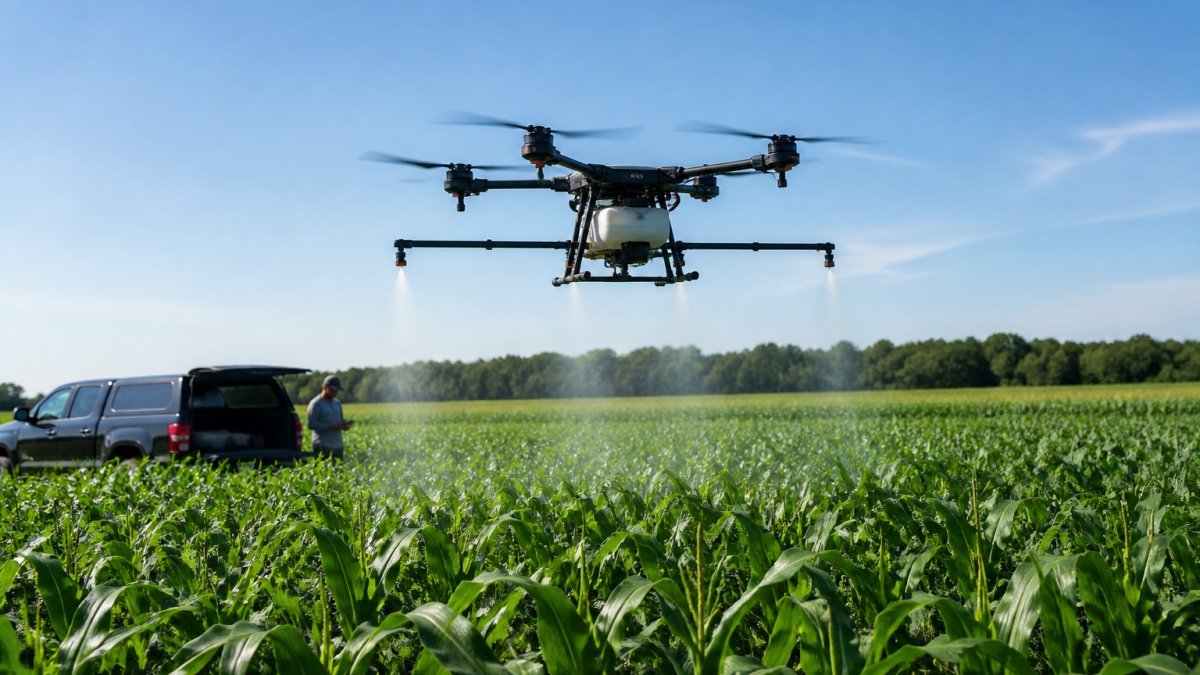
Drone precision spraying delivers fungicides and pesticides with accuracy ground equipment cannot match. The spray pattern from a drone creates smaller, more uniform droplets that penetrate the corn canopy better than traditional boom sprayers. This means better coverage of leaf surfaces where fungal diseases establish.
Early disease detection matters as much as application accuracy. Many growers don't realize a problem exists until significant damage appears. Multispectral drone imaging identifies crop stress before it's visible to the naked eye (Plant stress early detection through a low-cost multispectral device). You can see which fields or which sections of a field are struggling, then apply fungicides or other treatments immediately.
Targeted application also reduces the total chemical volume needed. Instead of blanket coverage across an entire field, you spray only the areas showing stress or disease risk. This cuts chemical waste, lowers input costs, and reduces runoff into waterways. Corn at different growth stages responds differently to inputs. A drone operator can adjust application timing and dosage based on the specific stage of growth in different field zones.
The combination of precise targeting and early detection creates a feedback loop. You catch problems sooner, treat them more accurately, and use less chemistry overall. This is the real efficiency gain most guides miss: it's not just about speed, it's about making every application count.
Drone Spraying Cost Per Acre and Return on Investment
Drone spraying cost per acre varies based on field size, chemical type, and application complexity. Smaller fields cost more per acre than large ones because fixed costs (mobilization, setup) spread across fewer acres. Custom applicators typically charge based on the number of acres treated and the chemical volume required.
The return on investment for drone precision spraying depends on what you're protecting. High-value crops like seed corn or specialty corn varieties justify higher application costs. A fungicide application that prevents a 10% yield loss on 100 acres of seed corn pays for itself quickly.
Timing affects ROI significantly. An early fungicide application that stops disease before it spreads costs less per unit of yield protection than a late treatment trying to salvage a failing crop.
Labor savings add to the equation. A drone operator covers more acres per day than a ground rig, and doesn't require someone to walk fields scouting for problems. Over a season, this labor advantage compounds. You're also reducing chemical inventory and handling because you're not mixing and applying excess volume.
Compare this to traditional spraying: a ground boom rig covers acreage more cheaply per application, but can't respond as quickly to emerging problems and often applies more chemistry than necessary. Drone precision spraying costs more per acre in the short term but typically delivers better disease control and lower total chemical cost over the season.
Corn Field Drone Mapping for Targeted Application
Corn field drone mapping creates a visual record of crop health and stress patterns across every acre. Multispectral sensors capture data in wavelengths the human eye can't see, revealing where plants are struggling even when the field looks green from the ground.
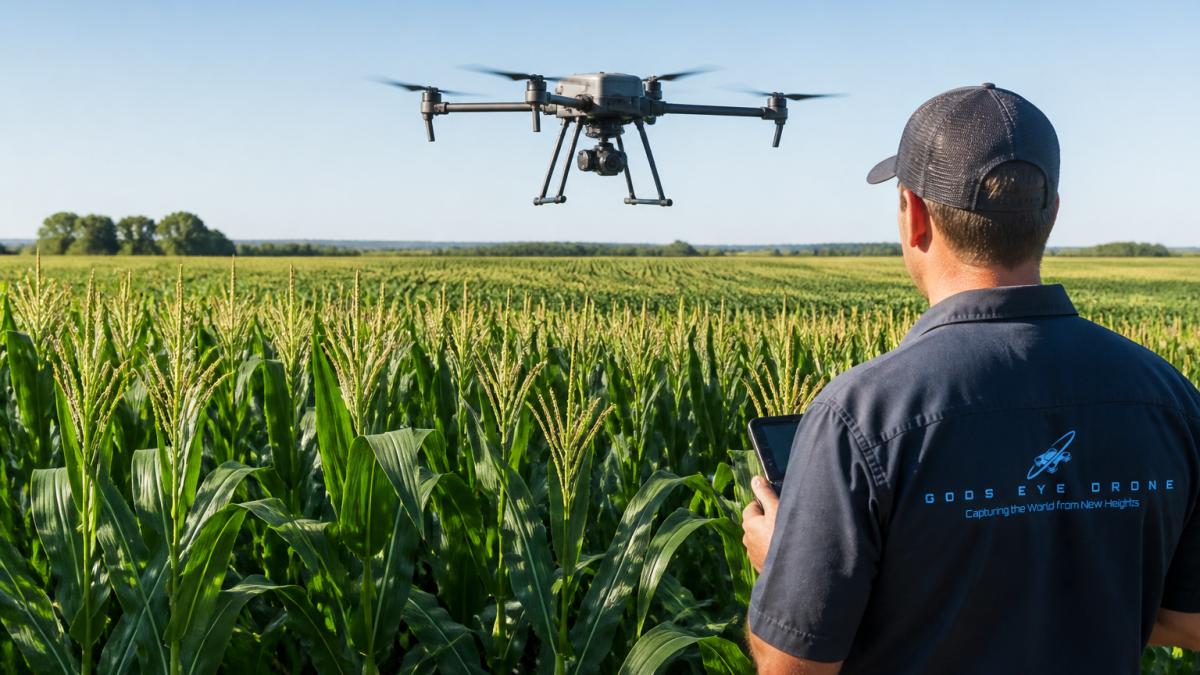
This data becomes a prescription map. Software analyzes the imagery and generates application maps showing exactly where and how much chemical to apply.
The mapping process happens quickly. A drone covers 100+ acres per flight. You get results within hours, not days. This speed matters during disease pressure windows when waiting a week for results means missing the optimal treatment timing.
Corn field drone mapping also identifies field problems you might otherwise miss. Compacted soil zones show up as stressed plants. Irrigation coverage problems become visible. Pest damage in one corner of the field that hasn't spread yet can be treated before it becomes a whole-field problem.
The data accumulates over seasons. You build a historical record of how your fields respond to treatments, where problems consistently emerge, and which zones consistently outperform others. This information guides future decisions about variety selection, fertility programs, and pest management strategy.
Drone Spray Coverage and Drift: Application Quality and Limitations
Drone spray coverage quality depends on several factors: droplet size, flight speed, wind conditions, and canopy density. A properly configured drone produces droplets that penetrate the corn canopy and coat leaf surfaces effectively. The small droplet size means better coverage with less total liquid volume.
Drift is the primary limitation. Drones operate at lower altitudes than manned aircraft, but they're still subject to wind. Droplets small enough to penetrate the canopy are also small enough to drift in wind.
This creates a timing constraint. You might identify a field that needs fungicide, but if wind is forecast to remain above threshold for three days, you wait. Missing that optimal treatment window can reduce effectiveness.
Application quality also depends on equipment calibration and operator experience. A drone that's poorly maintained or operated by someone without proper training delivers inconsistent results. Coverage gaps appear. Overdosing occurs in some areas while underdosing happens in others.
The limitation most growers underestimate is canopy density. Early-season applications when corn is 12-18 inches tall work well. Late-season applications when the plant is fully developed face challenges: the canopy is so dense that spray reaching the lower leaves becomes difficult.
Drone precision spraying also cannot replace scouting. The technology gives you better tools for targeting, but you still need to identify what problem you're treating.
Drone Spraying Regulations for Pesticides and Compliance
Drone spraying for agricultural use falls under Federal Aviation Administration Part 137 regulations, which govern aerial application of chemicals.
This is a significant requirement. It means you can't simply hire someone with a drone to spray your fields. They need formal training, testing, and FAA certification. The certification process includes written exams, practical flying tests, and demonstrated knowledge of agricultural aviation regulations.
Pesticide regulations add another layer. The EPA requires that all pesticide applications follow label instructions. This includes application rates, timing, safety buffers around non-target areas, and documentation. Drone operators must maintain detailed records of what was applied, when, where, and in what quantity.
State regulations vary. Some states require licensing for commercial pesticide applicators, even when they're using drones. Others have specific rules about spray buffer zones near sensitive areas like schools or water sources. Before hiring a drone operator, verify that they're compliant with your state's requirements.
Insurance is another compliance consideration. Liability coverage for agricultural drone operations is essential. If spray drifts onto a neighbor's field or causes damage, your liability insurance needs to cover it. Most professional operators carry this coverage, but it's worth confirming.
Documentation requirements are strict. The EPA and state agencies can request records of applications years after they occur. Operators must maintain spray logs showing the field location, chemical used, application rate, date, time, weather conditions, and operator name. Digital record-keeping systems make this easier than paper logs.
Operational Efficiency: Time Savings and Labor Reduction
Operational efficiency gains from drone precision spraying come in multiple forms. A drone covers 40-60 acres per hour, depending on field size, chemical type, and application pattern.
The real time savings appear in response time. When scouting identifies a disease pressure or pest issue, a drone can be airborne within hours. A ground rig must navigate field access roads, set up equipment, and manage the application carefully to avoid crop damage.
Labor reduction is significant. A drone operator and one assistant can cover as much acreage as a ground rig crew of two or three. Over a season, this compounds. You're not paying for as many hours of labor per acre treated.
Field access is another efficiency factor. Late-season applications when soils are wet are difficult or impossible with ground equipment. Drones operate regardless of soil conditions. This opens application windows that ground equipment cannot access.
Drone precision spraying also reduces the time spent on equipment maintenance. A ground rig requires regular maintenance, cleaning between chemical loads, and repairs when it breaks down in the field. A drone is simpler to maintain and can be serviced quickly if problems occur.
The operational efficiency doesn't mean drone spraying is always faster than ground application. For large, uniform fields where you're applying the same chemistry across all acres, a ground rig may be more economical.
Conclusion
Drone precision spraying represents a meaningful shift in how corn growers manage crop health and protect yields. The combination of accuracy, speed, and flexibility addresses real challenges that traditional methods struggle with. At Gods Eye Drone, we work with agricultural managers across the region to integrate drone spraying into their crop protection programs, and precision application technology offers significant value.
The decision to adopt drone spraying depends on your specific operation. Field size, crop value, disease pressure history, and labor availability all factor into the calculation. What matters is understanding what drone precision spraying actually delivers: better targeting, faster response, and more controlled chemical use. When those advantages align with your operation's needs, the investment makes sense. Book Now to discuss how precision aerial application can improve your corn management strategy.
| Benefit | Key Factor | Best For |
|---|---|---|
| Disease detection | Early identification | High-value varieties |
| Targeted application | Reduced chemical use | Large, diverse fields |
| Fast response | Compressed treatment windows | Disease-prone areas |
| Labor efficiency | Fewer operator hours | Operations with labor constraints |
| Field access | Weather-independent | Wet-season applications |
Frequently Asked Questions
What are the main benefits of drone precision spraying for corn?
Drone precision spraying can reduce chemical waste through targeted application, improve spray coverage in hard-to-reach field areas, detect crop stress and disease early through aerial monitoring, and allow application when ground equipment cannot access wet or muddy fields. The technology can also reduce drift and off-target chemical loss compared to traditional ground spraying, potentially protecting neighboring crops and reducing environmental impact.
How much does drone spraying cost per acre?
Drone spraying cost per acre depends on field size, chemical type, application complexity, and local service availability. For accurate pricing, contact a certified aerial applicator directly for a quote. Many operators offer volume discounts for larger acreage, and costs may vary based on whether you're applying fungicides, pesticides, or fertilizer.
What regulations govern drone spraying for pesticides?
The FAA requires aerial applicators to hold a Part 137 certificate and comply with Part 107 operational rules. EPA regulations govern pesticide application rates and safety buffers. Individual states may have additional licensing requirements for aerial applicators. Always verify local and state regulations before hiring a drone service, and confirm that pilots carry appropriate liability insurance and maintain current certifications for pesticide application.
Can drones spray corn when fields are too wet for ground equipment?
Yes. Drones operate from the air and never touch the ground, so they can spray when fields are muddy or saturated. This is a major advantage during wet springs or after heavy rain, allowing farmers to apply fungicides and pesticides on schedule without compacting soil or damaging crops with heavy ground equipment. This flexibility often prevents yield loss from delayed disease management.