 ultimate-guide
Advanced Pilot Training for Infrastructure Drone Inspections
Table of Contents
- Why Advanced Training Separates Inspection Pilots From Photographers
- The FAA Part 107 Remote Pilot Certificate: Your Baseline, Not Your Finish Line
- Drone Inspection Flight Skills That Only Practice Builds
- Drone Inspection Safety Procedures for Towers, Power Lines, and Bridges
- Drone Inspection Data Collection: Payloads, Image Capture, and Documentation
- Turning Raw Footage Into Asset-Management Workflows
- Training Costs, Course Formats, and Measuring Pilot Proficiency
- Conclusion
- Frequently Asked Questions
Last Updated: October 18, 2026
Why Advanced Training Separates Inspection Pilots From Photographers
Advanced pilot training for infrastructure drone inspections is the difference between pretty aerial pictures and evidence engineers, asset managers, and regulators can act on, and infrastructure drone inspections demand more than a camera in the sky.
Infrastructure inspection is a discipline of consistency, not creativity: the same tower must be photographed the same way on every visit so corrosion can be tracked over time.
The FAA Part 107 Remote Pilot Certificate: Your Baseline, Not Your Finish Line
The FAA Part 107 Remote Pilot Certificate is the legal minimum to fly a drone commercially and the starting point for infrastructure inspection work, not the credential that qualifies you for it. Passing the knowledge test proves you understand the rules, not that you can fly a precise orbit around a live transmission tower.
What the Knowledge Test Actually Covers
The Unmanned Aircraft General-Small (UAG) test covers regulations, airspace classification and operating requirements, weather, loading and performance, and emergency procedures. The FAA's official study materials for the Remote Pilot Certificate outline the full knowledge areas. What the test does not measure is stick-and-rudder competence, gimbal control, or the judgment to abort a mission when wind shifts.
Waivers and Airspace Authorizations for Critical Assets
Many infrastructure assets sit inside controlled airspace or near airports, so flight planning starts with airspace authorization requests well before the mission date. Operations beyond standard Part 107 limits, such as night flights or flights over people, require waivers. Pilots who work critical assets build these authorizations into the schedule rather than scrambling the week of the job.
Drone Inspection Flight Skills That Only Practice Builds
Drone inspection flight skills are the manual and perceptual abilities that let a pilot hold a stable hover at close range, fly a consistent orbit, and capture sharp imagery in conditions that punish sloppy inputs. No classroom covers these. Repetition does.
The core skills inspection pilots drill:
- Precision hovering at close proximity to structures, where GPS drift and prop wash both work against you
- Consistent orbit and grid patterns so the same asset is documented identically across visits
- Manual gimbal control to frame a defect at the right angle without re-flying the pass
- Wind and turbulence judgment, including knowing when to scrub a mission
- Obstacle awareness around guy wires, conductors, and bridge cabling that sensors may not detect
A common mistake is treating automated flight modes as a substitute for manual competence. Automated orbits fail near complex geometry, and the pilot who cannot take over smoothly is the pilot who clips a structure.
Advanced Flight Scenarios That Separate Trained Inspectors From Hobbyists
GPS-denied and GPS-degraded environments. Inside metal structures, under bridge decks, and near large steel assets, the aircraft may drop to ATTI mode or refuse to hold position.
Wind and gust management. Wind at altitude is not the wind at the launch point.
Obstacle-dense geometry. Guy wires, catenary conductors, bridge cabling, and antenna arrays are thin, low-contrast, and frequently outside the detection envelope of obstacle-avoidance sensors.
What Proficiency Looks Like in the Field
A trained inspection pilot is recognized by behavior, not certificate. They brief the mission and abort triggers before launch, fly the same pattern on the same asset visit after visit, can explain why a pass was re-flown, and hand over imagery a reviewer can trace to a specific structural element without a phone call. Those habits come from deliberate practice on complex scenarios, and they are what clients pay for.
Drone Inspection Safety Procedures for Towers, Power Lines, and Bridges
Drone inspection safety procedures for towers, power lines, and bridges center on distance management, electromagnetic awareness, and a documented pre-flight risk assessment for every mission. Safety here is procedural, not instinctive.
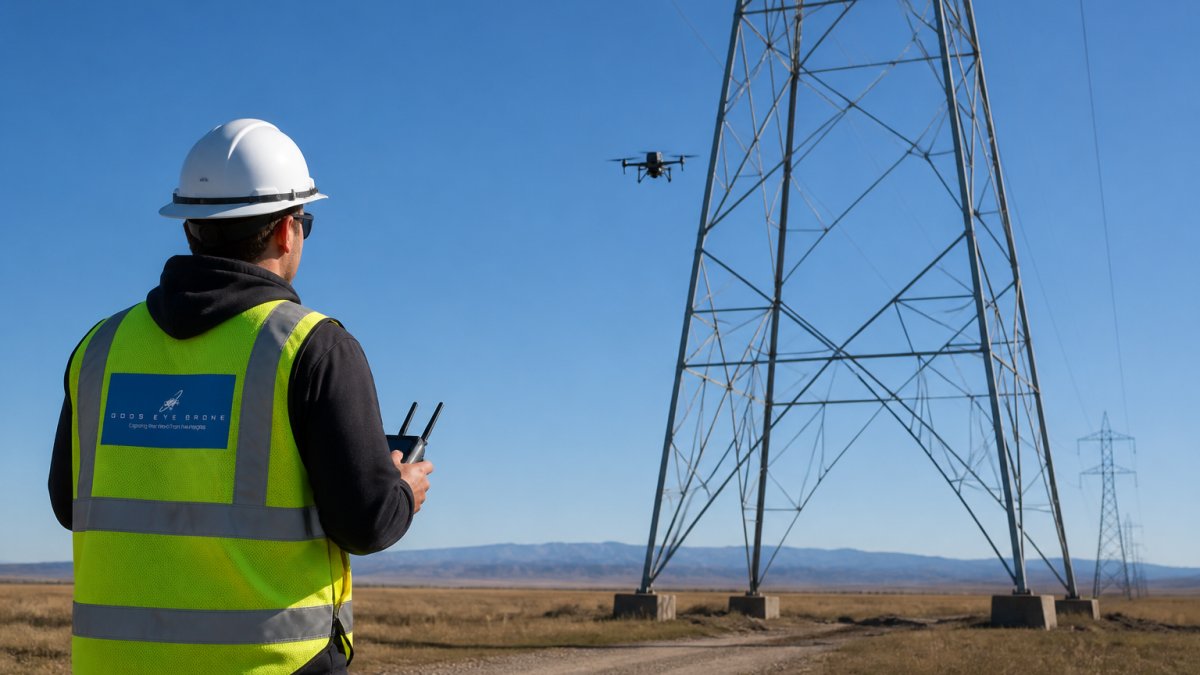
Key procedures include maintaining standoff distance from energized conductors, checking for electromagnetic interference that can disrupt compass and GPS, establishing a visual observer position with clear line of sight, and defining a hard abort trigger before launch. The FAA's drone operations and safety guidance sets the operating framework; site-specific rules from the asset owner layer on top of it.
Drone Inspection Data Collection: Payloads, Image Capture, and Documentation
Drone inspection data collection means capturing imagery and sensor readings in a structured, repeatable format that supports condition assessment and defect identification. The payload you choose determines what defects you can actually see.
Choosing Sensors for the Asset You Are Inspecting
Sensor selection should follow the defect type you are hunting, not the drone you own. A high-resolution visible-light camera with a mechanical shutter captures surface cracking and corrosion on concrete and steel; thermal payloads reveal moisture intrusion, insulation failures, and overheating electrical components; multispectral sensors serve vegetation and agricultural asset monitoring.
Gods Eye Drone's use of advanced FLIR thermal equipment reflects this principle: the sensor is matched to the inspection objective, and thermal data is captured alongside visible imagery so findings can be cross-referenced.
| Asset Type | Primary Payload | Secondary Payload | What It Reveals |
|---|---|---|---|
| Transmission towers | High-resolution visible camera | Thermal | Corrosion, loose hardware, hot joints |
| Power lines | Zoom visible camera | Thermal | Conductor wear, vegetation encroachment |
| Bridges | High-resolution visible camera | Thermal | Concrete cracking, delamination, moisture |
| Roofs | Visible camera | Thermal | Membrane damage, trapped moisture |
| Solar arrays | Thermal | Visible camera | Cell hot spots, physical damage |
Turning Raw Footage Into Asset-Management Workflows
Raw footage becomes useful only when processed into an asset-management workflow: organized by asset ID, tagged by defect type, and delivered in a format the client's maintenance system can ingest. This is the step most inspection operations handle worst, and the one that determines whether the client renews.
A practical workflow looks like this:
- Organize by asset and date so any image can be traced to a structure and a visit
- Tag defects with location, severity, and type during review
- Cross-reference thermal and visible captures of the same defect
- Deliver in the client's format, whether that is a report, a shared folder structure, or an import file for their asset-management platform
- Archive the raw data so future visits can be compared against a baseline
That outline is the skeleton. The depth is in the mechanisms.
From Imagery to a Measurable Record
Defect tagging schema. Ad hoc tagging produces a folder no one can search.
Thermal and visible cross-referencing. A thermal hot spot on a solar array or an electrical joint is only actionable when paired with the visible image of the same component.
Archiving and baseline comparison. Archive raw imagery, processed models, and the tagging record together so a future visit can be compared against a known baseline.
Integrating With Maintenance Systems
Asset owners typically run maintenance through a CMMS or EAM platform, and the deliverable is most valuable when it creates or updates work orders directly.
A simple test of whether the workflow is working: can the client open the deliverable, find a specific defect on a specific component, and create a work order without calling the pilot? If not, the data workflow is not finished.
Training Costs, Course Formats, and Measuring Pilot Proficiency
Training costs for advanced inspection pilot programs depend on course format, duration, and whether the program includes hands-on flight time or online-only instruction. Pricing varies widely by provider, so request a quote rather than assuming a figure.
Course formats fall into three broad categories:
- Online knowledge courses covering inspection methodology, regulations, and data workflows
- In-person practical courses with supervised flight time on real or simulated infrastructure
- Hybrid programs combining online theory with field days for hands-on practice
Measuring proficiency is where most programs fall short: a certificate proves attendance, not competence. Define measurable outcomes, can the pilot hold a stable hover at a specified distance, fly a repeatable orbit, and produce imagery that passes quality review?
Conclusion
The hardest part of advanced inspection training is not passing the knowledge test. It is building the flight precision, safety discipline, and data workflow that turn a certified pilot into an inspection professional, and most programs stop short of that.
Gods Eye Drone is a veteran-owned, full-service drone company with certified pilots and state-of-the-art technology, including advanced FLIR equipment, built for precise aerial inspections across infrastructure, real estate, and agricultural assets.
Book Now with Gods Eye Drone and get aerial intelligence you can actually act on.
Frequently Asked Questions
What training do drone pilots need for infrastructure inspections?
Start with the FAA Part 107 Remote Pilot Certificate, which is legally required for commercial work. From there, look for hands-on courses that cover close-proximity flight around towers, bridges, and power lines, plus image capture and documentation standards. Many employers also expect familiarity with thermal and zoom payloads, mission planning software, and basic structural defect identification. A practical course with supervised flight time teaches more than an online certificate alone.
Does infrastructure drone inspection require an FAA Part 107 certificate?
Yes. Any commercial infrastructure drone inspection falls under FAA Part 107 rules, so the remote pilot in command must hold a Remote Pilot Certificate with a small UAS rating. You earn it by passing the Unmanned Aircraft General-Small knowledge test at an FAA-approved testing center. Flying without it exposes you and your client to civil penalties, and most asset owners will ask for proof of certification before granting site access.
How do drone pilots inspect bridges, towers, and other structures safely?
Safe structure inspection relies on maintaining a planned standoff distance, flying with obstacle avoidance active, and keeping visual line of sight at all times. Pilots check wind speed at height, set a geo-fence around the asset, and fly systematic passes rather than freehand. Never fly directly over workers or traffic without coordination. A written drone inspection safety procedures checklist, reviewed before every mission, prevents the rushed improvisation that causes most incidents.
What equipment do pilots use for infrastructure drone inspections?
Most inspection crews fly a commercial airframe with a high-resolution zoom camera, a thermal sensor such as FLIR, and sometimes a LiDAR or multispectral payload. A rugged controller, spare batteries, and a tablet running mission planning software round out the kit. Sensor choice depends on the asset: thermal for electrical hot spots, high-zoom RGB for concrete cracking, LiDAR for geometry. Match the payload to the defect you need to find before you book the flight.
How can drone pilots improve inspection data quality?
Consistency beats resolution. Fly the same altitude, speed, and overlap on every pass so images can be compared over time. Shoot in RAW, lock exposure, and capture overlapping frames for photogrammetry. Label files with asset ID, date, and location before leaving the site. Strong drone inspection data collection habits, including a pre-flight shot list and post-flight review, cut reflights and make the deliverable usable for asset-management systems.
How long does it take to train for infrastructure drone inspections?
Expect two to four weeks of study for the Part 107 knowledge test, then several weeks of supervised flight practice to build close-proximity confidence. A focused hands-on inspection course typically runs a few days to a couple of weeks. Reaching genuine proficiency on complex assets like energized transmission towers usually takes months of logged missions. Budget ongoing practice time, not just a one-time course.