 ultimate-guide
Hydrogen-Powered HAPS for Remote Sensing: 2026 Guide
Table of Contents
- What Are Hydrogen-Powered HAPS and Why They Matter for Remote Sensing
- Hydrogen Fuel Cell UAV Technology: The Propulsion Advantage
- HAPS Remote Sensing Applications: Real-World Use Cases
- FAA Regulations for High-Altitude Unmanned Systems
- Lifecycle Environmental Impact and Maintenance Infrastructure
- Data Latency, Processing, and Operational Readiness
- The Path Forward for Hydrogen-Powered HAPS
- Frequently Asked Questions
Last Updated: October 3, 2026
What Are Hydrogen-Powered HAPS and Why They Matter for Remote Sensing
Hydrogen-powered HAPS (High-Altitude Platform Systems) represent a fundamental shift in how organizations conduct persistent surveillance, environmental monitoring, and telecommunications across large geographic areas. Traditional approaches to aerial intelligence, whether relying on conventional drones or satellite systems, come with inherent limitations.
HAPS are pseudo-satellite unmanned aircraft systems designed to hover at altitudes between 60,000 and 100,000 feet for weeks or months.
Remote sensing applications span agriculture (multispectral imaging for irrigation and crop health), infrastructure inspection, and emergency response. Each demands extended flight duration, reliable power, and the ability to maintain station over a target area, exactly what hydrogen fuel cell technology delivers.
How HAPS Differ From Traditional Drones and Satellites
Traditional drones operate below 500 feet with flight times of minutes to hours. Satellites orbit at 22,000+ miles with fixed revisit schedules days apart. HAPS occupy a distinct niche: stratospheric altitudes where they remain stationary relative to a ground point, delivering persistent coverage with flexible payload and mission adjustments.
A conventional drone requires repeated launches for time-series data, each incurring mobilization costs, pilot time, and weather delays. A hydrogen-powered HAPS maintains continuous station for weeks, capturing data at consistent times and atmospheric conditions, yielding higher-quality monitoring with lower operational overhead.
Satellites excel at global coverage but cannot provide real-time tactical response. HAPS excel at regional persistence and adaptive operations, for example, maintaining continuous ISR coverage over a border corridor with the ability to adjust sensor payload or altitude based on emerging threats, impossible with orbital systems.
Hydrogen Fuel Cell UAV Technology: The Propulsion Advantage
Hydrogen fuel cells deliver 33 kilowatt-hours per kilogram versus 0.25 for lithium-ion batteries, a 130-fold advantage. For HAPS designed to remain aloft for weeks, this translates directly into payload capacity, altitude capability, and mission flexibility.
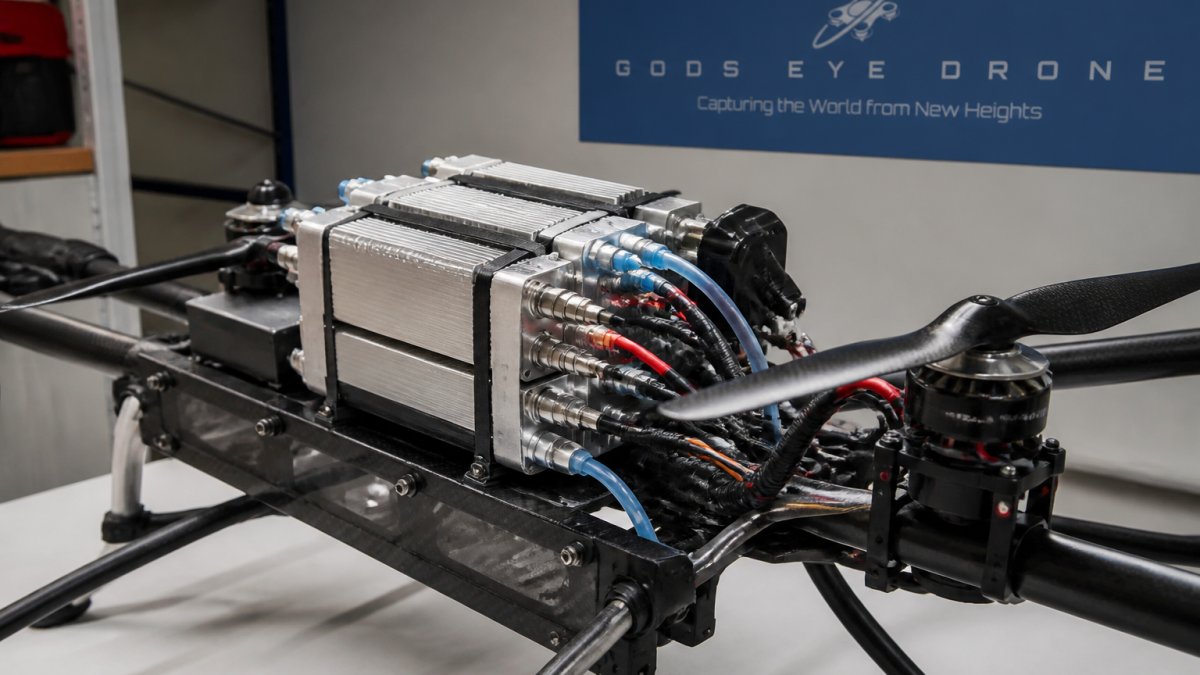
The propulsion system combines a fuel cell stack with electric motors driving efficient propellers optimized for stratospheric flight. At 60,000+ feet, the thin atmosphere demands high aspect-ratio propellers and lightweight airframes. Hydrogen fuel cells provide sustained electrical output to maintain altitude while carrying meaningful sensor payloads.
Energy Density and Flight Endurance Benefits
A battery-powered HAPS achieves 8-12 hours of flight; a hydrogen fuel cell system sustains 2-4 weeks of continuous operation. That extended endurance transforms remote sensing economics.
A satellite revisits on fixed schedules; a conventional drone requires repeated launches. A hydrogen-powered HAPS maintains continuous station, capturing imagery at consistent local solar times. Agricultural managers gain daily multispectral data under identical lighting; environmental scientists track coastal erosion or wetland dynamics in real time.
Satellite imagery requires subscription fees; conventional drones require pilot mobilization and weather windows. A hydrogen-powered HAPS, once operational, generates continuous data with minimal incremental cost. Capital investment is substantial, but per-mission cost becomes negligible across weeks or months of deployment.
Hydrogen Storage and Safety Protocols
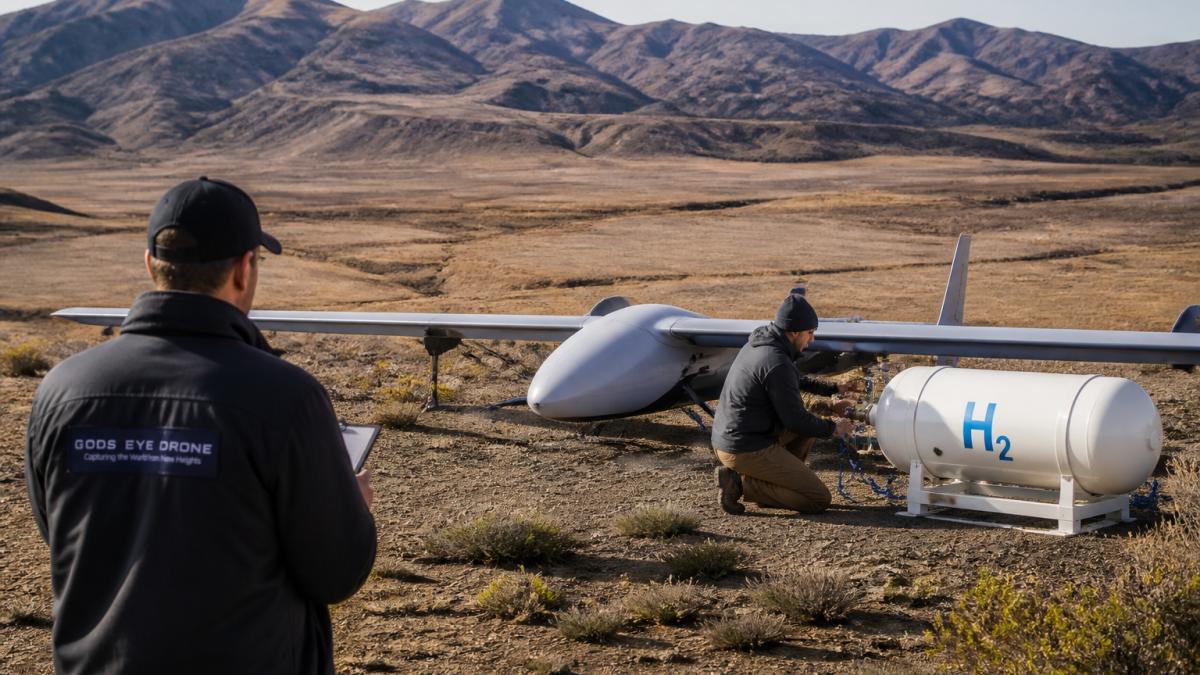
Liquid hydrogen storage requires rigorous safety protocols. Stored cryogenically at -253°C, it demands insulated tanks, careful handling, and strict separation from ignition sources and oxygen-rich environments.
Ground infrastructure includes cryogenic storage, fuel transfer equipment, and specialized maintenance. A HAPS operating base requires personnel trained in cryogenic safety and fuel cell operation. The learning curve is steeper than conventional drones, but extended endurance justifies the investment for persistent surveillance or continuous monitoring.
Safety protocols include automated pressure relief systems, flame arrestors, and segregated fueling areas. Regular inspections of fuel lines, valve seals, and tank integrity prevent leaks. These requirements align with the professionalism and reliability critical operations demand.
HAPS Remote Sensing Applications: Real-World Use Cases
Hydrogen-powered HAPS deliver persistent intelligence across three domains: Earth observation, telecommunications, and security operations, each leveraging extended endurance and flexible sensor payloads.
Earth Observation and Environmental Monitoring
Agricultural managers depend on multispectral imaging to optimize irrigation and monitor crop health. A hydrogen-powered HAPS maintains continuous station, capturing daily imagery that reveals subtle vegetation changes. Unlike satellites constrained by revisit schedules and cloud cover, HAPS observe the same field under consistent conditions daily.
Environmental monitoring extends to wetlands, coastal erosion, and forestry fire risk assessment. These applications share a common requirement: frequent observations of the same area under consistent conditions, exactly what hydrogen-powered HAPS deliver.
Telecommunications and Broadband Coverage
Telecommunications providers face persistent challenges delivering broadband connectivity to rural or underserved regions. Satellites provide global coverage but suffer from latency and limited bandwidth. Conventional wireless infrastructure requires expensive tower construction. A hydrogen-powered HAPS, positioned at stratospheric altitude, can provide broadband connectivity across a region the size of a small state, with latency comparable to terrestrial systems and deployment timelines measured in weeks rather than years.
The HAPS platform carries a telecommunications payload, essentially a high-power transmitter and receiver, that relays signals between ground stations and end users. A single HAPS can replace dozens of cellular towers across sparsely populated regions. Emergency response teams gain reliable communications during disasters when conventional infrastructure fails. Remote communities gain access to broadband for education, telemedicine, and economic opportunity.
ISR and Border Security Operations
Intelligence, Surveillance, and Reconnaissance (ISR) operations demand persistent coverage, real-time data transmission, and the flexibility to adjust sensor payloads based on emerging threats. A hydrogen-powered HAPS maintaining continuous station over a border corridor or critical infrastructure zone provides exactly that capability. Equipped with electro-optical sensors, infrared imaging, or signals intelligence (ELINT) receivers, the platform delivers uninterrupted situational awareness.
Border security agencies benefit from persistent surveillance that detects unauthorized crossings or suspicious activity in real time. Infrastructure protection teams monitor critical assets, power plants, water systems, transportation corridors, with continuous remote sensing. Military and intelligence operations use the platform's endurance and flexibility for extended ISR missions. The hydrogen fuel cell propulsion system enables these operations to continue for weeks without requiring aircraft recovery, refueling, or maintenance cycles.
FAA Regulations for High-Altitude Unmanned Systems
The Federal Aviation Administration (FAA) maintains strict oversight of unmanned aircraft operations, with particularly rigorous requirements for high-altitude systems. A hydrogen-powered HAPS operating in the stratosphere must comply with multiple regulatory frameworks addressing airspace access, operational procedures, and system certification.
Stratospheric Flight Approval and Airspace Restrictions
Stratospheric airspace above 60,000 feet falls under FAA jurisdiction but remains largely unregulated for unmanned operations. The FAA has not yet established a comprehensive certification framework for HAPS, creating a regulatory gray area that operators must navigate through case-by-case approvals. Most current HAPS operations occur under experimental certificates or special flight authorizations that impose specific operational restrictions, altitude limits, and reporting requirements.
Airspace access below the stratosphere, from ground level to 60,000 feet, is heavily regulated. The FAA requires airspace authorization for unmanned operations above 400 feet or within controlled airspace. A HAPS ascending or descending through this airspace must coordinate with air traffic control and comply with separation requirements. Many HAPS operations plan flight corridors through designated military airspace or remote areas to minimize conflicts with manned aviation.
Certification Requirements and Operational Permits
The FAA's Part 107 regulations govern small unmanned aircraft operations but do not address stratospheric HAPS. Operators pursuing HAPS missions typically work with the FAA's Unmanned Aircraft Systems Integration Pilot Program (IPP) or request special flight authorizations under Part 91. These approvals require detailed safety cases demonstrating that the HAPS operation poses no undue risk to manned aviation, people, or property.
Certification requirements typically include proof of airworthiness, operational procedures manuals, pilot training and qualification standards, and emergency response plans. For hydrogen-powered systems, the FAA requires additional documentation addressing fuel system safety, cryogenic handling procedures, and emergency descent protocols. Organizations supporting critical operations, search and rescue, infrastructure inspection, emergency response, maintain the certifications and insurance coverage that regulatory agencies and customers demand.
Lifecycle Environmental Impact and Maintenance Infrastructure
The environmental case for hydrogen-powered HAPS rests on two factors: the emissions profile of hydrogen production and the operational efficiency of fuel cell systems. If hydrogen is produced through renewable energy sources, electrolysis powered by wind or solar, the lifecycle carbon footprint becomes negligible.
Maintenance infrastructure for hydrogen-powered HAPS is more complex than conventional drones. Cryogenic storage facilities, fuel transfer equipment, and specialized service procedures require trained personnel and dedicated facilities. A HAPS operating base includes pressure vessels, insulation systems, and safety equipment that conventional drone operations do not require.
Ground infrastructure also includes launch and recovery equipment. HAPS are typically launched from catapult systems or runway facilities rather than hand-launched. Recovery may involve parafoil descent or runway landing, depending on platform design.
Data Latency, Processing, and Operational Readiness
A hydrogen-powered HAPS transmits data continuously during its deployment, creating massive data streams that require strong processing infrastructure. A multispectral imaging payload might generate terabytes of data per week. Real-time ISR operations demand latency measured in seconds, not hours. Telecommunications applications require near-instantaneous signal relay.
Data latency depends on ground station architecture and processing pipeline design. A HAPS equipped with onboard processing capability can transmit analyzed data products (e.g., detected anomalies, processed imagery) rather than raw sensor streams, reducing bandwidth requirements.
Operational readiness for a hydrogen-powered HAPS involves pre-deployment checks of fuel systems, payload integration, communications links, and emergency procedures. A typical deployment cycle includes fuel tank pressurization, thermal management system activation, and communications verification before launch. Once aloft, the platform operates autonomously with periodic ground station contact for mission adjustments or emergency procedures.
The Path Forward for Hydrogen-Powered HAPS
Hydrogen-powered HAPS represent a maturing technology with substantial operational potential across agriculture, infrastructure, telecommunications, and security applications. The extended endurance, persistent coverage, and payload flexibility that fuel cell propulsion enables address real operational gaps that neither conventional drones nor satellites can fill independently.
The regulatory environment remains the primary constraint. As the FAA develops comprehensive certification frameworks for stratospheric HAPS operations, deployment timelines will accelerate and operational costs will decline. Early adopters, organizations conducting persistent surveillance, continuous environmental monitoring, or emergency response operations, are pioneering operational concepts that will inform regulatory development.
For organizations considering hydrogen-powered HAPS for remote sensing missions, the investment case hinges on operational requirements. If your mission demands extended endurance, persistent coverage, or continuous data collection over a fixed geographic area, a HAPS platform delivers capabilities that conventional drones cannot match.
At Gods Eye Drone, we recognize that emerging technologies like hydrogen-powered HAPS represent the frontier of aerial intelligence. Whether you're conducting agricultural multispectral analysis, infrastructure inspection, or emergency response operations, we deliver the aerial perspective and technical expertise your mission demands. Book Now to discuss how conventional aerial platforms can enhance your operational intelligence.
Frequently Asked Questions
What are the primary advantages of hydrogen-powered HAPS over battery-powered drones?
Hydrogen fuel cells deliver significantly higher energy density than lithium batteries, enabling flight durations measured in days rather than hours. A hydrogen-powered HAPS can maintain stratospheric altitude for extended periods, making it ideal for persistent remote sensing, telecommunications relay, and continuous Earth observation. Battery systems cannot achieve this endurance without prohibitive weight penalties. Hydrogen also produces only water vapor as a byproduct, eliminating emissions during operation.
How do HAPS contribute to real-time remote sensing and earth observation?
HAPS remote sensing applications include multispectral imaging, thermal monitoring, and high-resolution photography from 60,000+ feet. Operating in the stratosphere above weather systems and most air traffic, HAPS platforms provide persistent surveillance without cloud cover obstruction. They can monitor agricultural fields, environmental changes, infrastructure conditions, and disaster response areas continuously. The pseudo-satellite nature of HAPS means consistent ground coverage with minimal data latency compared to traditional satellite passes.
What regulatory challenges do hydrogen-powered HAPS face in the United States?
FAA regulations for high-altitude unmanned systems remain evolving. Current restrictions limit most UAS operations below 400 feet, but HAPS operating in the stratosphere require special airspace authorization. Hydrogen storage and handling must meet hazardous materials protocols. Operators need Part 107 certification and beyond, plus specific waivers for stratospheric flight. Environmental and safety assessments add approval timelines. The regulatory framework is becoming clearer, but operators must work closely with the FAA to secure experimental or operational permits for hydrogen-powered systems.
Are hydrogen-powered HAPS currently used for commercial remote sensing operations?
Hydrogen-powered HAPS are in advanced development and limited commercial deployment. Several aerospace companies operate experimental platforms for government agencies, telecommunications providers, and environmental monitoring programs. Commercial availability is growing, particularly for Earth observation, border security ISR, and emergency response telecommunications. Most current operations remain in the defense and government sector, but private sector adoption for agriculture, infrastructure inspection, and disaster response is accelerating. Costs and regulatory approval timelines currently limit widespread commercial use.