 How-to
5 Essential Steps for Preparing Corn Fields for Drone Spraying
Last Updated: November 16, 2026
Quick Summary
Preparing corn fields for drone spraying requires a systematic approach involving hazard identification, clear communication with your applicator, and thorough site maintenance. By completing a comprehensive checklist two to three days before the flight, you ensure a safe, efficient mission that protects your crop and maximizes the effectiveness of your fungicide application.
- Walk the field perimeter to record GPS points for all obstacles taller than the corn.
- Mow and firm a level launch and landing pad roughly 20 to 30 feet wide.
- Verify that the product label allows for aerial application at the current crop growth stage.
- Confirm that your water source has enough flow to refill the drone tank between loads.
- Flag new hazards like irrigation pipes or downed wires the day before the scheduled flight.
Table of Contents
- Why Professional Preparation Matters for Corn Fungicide Drone Application
- Optimizing Drone Spray Coverage in Corn
- Your Comprehensive Agricultural Drone Spraying Checklist
- Monitoring Drone Spraying Weather Conditions
- Managing Field Boundaries and Obstacles When Preparing Corn Fields
- Coordinating with Your Aerial Applicator for Success
- Booking Your Next Aerial Precision Application
- Frequently Asked Questions
Why Professional Preparation Matters for Corn Fungicide Drone Application
Effective corn fungicide drone application relies on careful field preparation to ensure safety and coverage. Precision starts on the ground before the equipment ever takes flight. This guide from Gods Eye Drone covers how to set up your site for a successful mission.
Ground equipment often causes significant damage to tall-canopy crops during later growth stages, whereas drones can reach sloped fields and wet soil without leaving tracks Benefits of spray drones in agriculture. Moving to aerial methods may offer benefits for yield protection and treatment consistency.
Optimizing Drone Spray Coverage in Corn
Achieving uniform spray coverage requires balancing flight height with the specific droplet size needed for your crop protection product. Specialists at the University of Kentucky are currently testing these drone-based applications to ensure they effectively treat foliar corn UK research on drone fungicide application.
When optimizing your setup, consider these factors:
- Select the correct nozzle tip for your target droplet size
- Use the right adjuvant to improve leaf adhesion and coverage
- Calibrate the drone for the specific height above the canopy
- Check that your application rate matches the product label requirements
If you want to take your efficiency further, you can learn how variable rate technology improves coverage. This allows you to apply products exactly where the crop needs them most.
Your Comprehensive Agricultural Drone Spraying Checklist
Creating an agricultural drone spraying checklist is the best way to avoid mistakes on the day of your application. Professional preparation reduces downtime and ensures your pilot has a clear path to complete the job safely. The checklist below is sequenced by when each task should happen, because most failures trace back to something that was skipped two or three days before the drone arrived rather than to the flight itself.
Two to three days before the application
- Walk the field perimeter and the intended flight lanes and note every obstacle taller than the corn: trees, poles, grain bins, center-pivot towers, and overhead wires. Record each one as a GPS point, not a description.
- Confirm the product label allows aerial application to corn at the growth stage present, and note the labeled rate, the maximum number of applications per season, the pre-harvest interval, and any required adjuvants or spray volume. Keep the label and the safety data sheet on hand for the pilot.
- Confirm a water source and refill location. Aerial applicators typically need a fill point within a short drive of the field, with enough flow to refill the tank between loads; a distant or low-flow source adds hours to the day.
- Mow and firm a level launch and landing pad roughly 20 to 30 feet on a side, clear of tall vegetation, dust, and loose gravel that the rotors will throw.
- Notify neighbors, the farm crew, and anyone who works adjacent ground of the date, the product, and the expected window so people and livestock can be kept clear.
The day before
- Re-walk the field and flag any new hazards: irrigation pipe moved into the lanes, a parked truck, a downed wire, or a newly dug trench.
- Confirm the digital field map matches the ground. Check that boundaries, exclusion zones, and any sensitive areas such as ponds, apiaries, or organic blocks are drawn correctly and that the map's acreage matches your own records.
- Verify the forecast against your go/no-go thresholds (see the weather section) and agree on a backup date.
- Confirm the application rate, total product volume, and number of loads with the applicator so the product can be staged and mixed correctly.
The morning of the application
- Confirm the field is free of livestock and unauthorized people and that gates are open or access is arranged.
- Check that the launch pad is still clear and that wind direction will carry any drift away from sensitive areas.
- Hand the pilot the label, the field map, the hazard list, and an emergency contact who can be reached during the flight.
- Record the start time, the product and rate applied, the weather conditions at application, and the acres treated. Many states require application records to be kept for a set period, and the applicator will need this information for the report.
Watch out: skipping the label review is the most common and most expensive shortcut, applying an off-label rate or at the wrong growth stage can void the product's performance claims, create residue problems at harvest, and expose both the grower and the applicator to enforcement action.
Monitoring Drone Spraying Weather Conditions
Weather is the most critical factor for any drone mission. High wind speeds can cause chemical drift, which reduces the effectiveness of your application and poses a risk to nearby crops.
Always check these conditions before you start:
- Wind speed: Keep it well below the drone manufacturer's limits
- Temperature: Avoid spraying during the hottest part of the day
- Humidity: Monitor levels to prevent rapid evaporation of droplets
- Precipitation: Ensure no rain is expected during or shortly after the flight
Watch out: spraying in high winds can lead to product drift, which may damage neighbors' fields or lead to regulatory non-compliance. Always follow local wind threshold guidance.
Managing Field Boundaries and Obstacles When Preparing Corn Fields
Field boundaries and obstacles represent the highest risk to your equipment and your crop. When preparing corn fields for drone spraying, you must ensure the flight path is clear of hidden dangers.
If you need help mapping your specific layout, choose flight planning software for large fields to accurately define your operational area. This software helps you identify potential power lines or structures that might not be visible from the ground.
Key tasks for boundary management include:
- Removing small debris that could interfere with landing gear
- Identifying low-hanging wires that cross the field
- Ensuring the pilot has a clear line of sight to the entire area
- Marking the location of any underground utility access points
Coordinating with Your Aerial Applicator for Success
Successful applications require clear communication between the grower and the operator. When you are preparing corn fields for drone spraying, you should discuss the timing of the fungicide application relative to the crop growth stage, because the window when a fungicide pays for itself in corn is narrow and a drone crew that arrives a week late may be spraying a canopy that no longer needs protection.
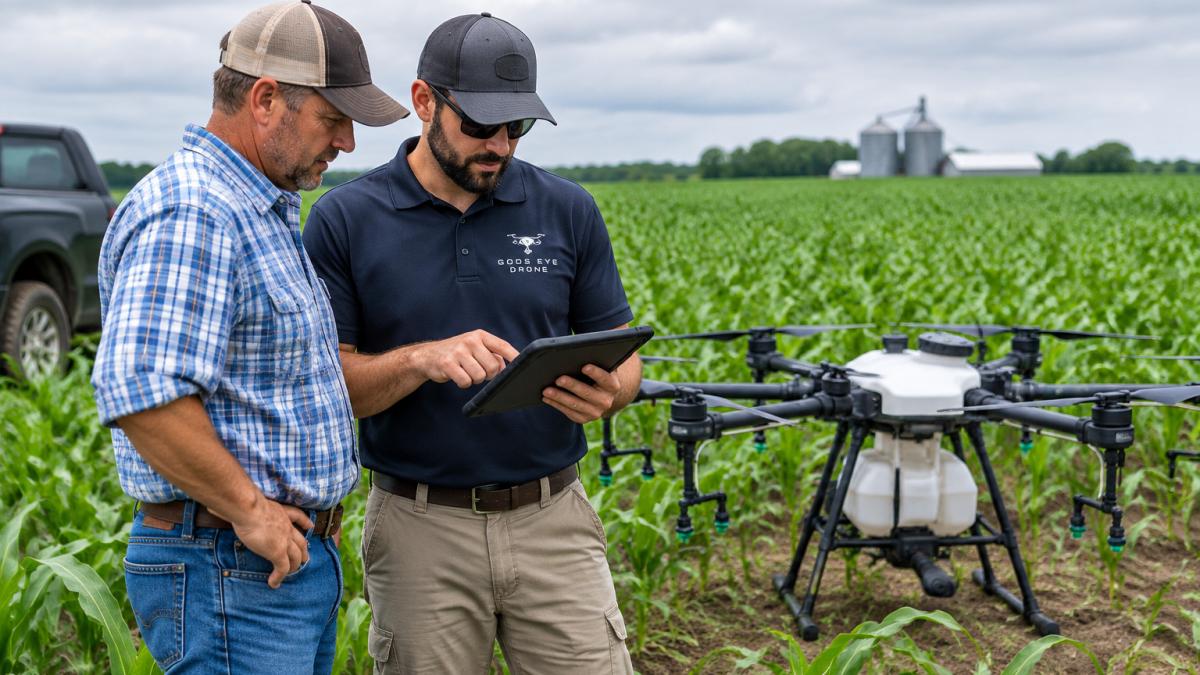
Before your pilot arrives, ask these questions to ensure a qualified drone operator is handling your field. Establishing a clear plan for recordkeeping and label compliance is also essential for a smooth experience. The most useful way to structure the conversation is to treat it as a handoff of four things: the field, the product, the logistics, and the emergency plan.
The field
- Share the digital field map and boundary coordinates in a format the applicator's software can import, and confirm the acreage both parties are pricing.
- Identify the launch site, the access route to it, and any gates, locks, or permission needed to reach it.
- List every hazard you found on the walk-through, with GPS points, and mark any no-spray zones such as waterways, wellheads, or neighboring sensitive crops.
The product
- Confirm the exact product, formulation, labeled rate, spray volume, and any required adjuvant, and agree on who supplies and mixes the product.
- Share the label and safety data sheet in advance so the pilot can confirm the drone's nozzles and droplet size are appropriate for the product.
- Agree on how unused product and rinse water will be handled at the end of the day.
The logistics
- Confirm the water source, refill point, and expected number of loads, and make sure the refill area is accessible to the support vehicle.
- Agree on a start time, a weather decision time, and a backup date.
- Confirm who is responsible for recordkeeping and what information the applicator needs from you to complete the application record.
The emergency plan
- Exchange cell numbers for the pilot, the grower, and a second contact who can be reached if the first is unavailable.
- Agree on what happens if the drone loses connectivity, the battery runs low mid-field, or the wind picks up: where the aircraft will be landed, who retrieves it, and who is notified.
- Confirm the nearest hospital and the procedure for reporting a spill or a drift incident to the state lead agency.
Watch out: assuming the applicator will handle everything is a common source of friction, the grower usually owns the product label decision, the field access, and the water, while the applicator owns the flight and the application record, and unclear division of those responsibilities is what turns a routine job into a dispute.
Booking Your Next Aerial Precision Application
Booking professional drone services allows you to focus on your farm management while experts handle the technical side of the application. Before you commit to a service, you should understand the pricing structure for drone mapping so you know what to expect from your investment.
Aerial applications are a powerful tool for modern farming. By properly preparing your property, you ensure the best possible results for your corn crop.
Managing the logistics of aerial applications can be a challenge. We provide the expertise and technology to ensure your field is ready for a safe, efficient, and precise application every time. Get started with Gods Eye Drone and improve your crop health with our state-of-the-art technology and certified drone pilots.
Frequently Asked Questions
How should you start preparing corn fields for drone spraying?
Start by identifying all obstacles such as power lines, trees, and irrigation pivots. Once identified, clear a dedicated launch site that is flat, stable, and free of debris. Precise field mapping is vital to ensure the drone follows an efficient path. Proper preparation allows drones to navigate fields where ground equipment might cause damage to tall-canopy crops, which may be beneficial when soil conditions are too wet for heavy ground rigs.
What are the ideal drone spraying weather conditions?
Optimal drone spraying weather conditions require low wind speeds to prevent spray drift and ensure the product lands on the target area. Avoid spraying during high heat, as evaporation can reduce the effectiveness of the fungicide. Always check local forecasts and use professional-grade monitoring to determine if wind, humidity, and temperature are within the safe operating parameters for your specific crop protection product. Consistency in these conditions is necessary to achieve uniform coverage across the entire field.
What is the best way to plan drone spray coverage in corn?
To achieve uniform drone spray coverage in corn, calibrate the droplet size and select the correct adjuvant based on the product label. Flight planning should account for the crop growth stage, as canopy density influences how well the fungicide penetrates the target leaves. Aligning the flight height with the specific needs of the corn can help optimize the spray pattern.