 How-to
What Weather Conditions Are Best for Drone Spraying Corn?
Last Updated: November 16, 2026
Quick Summary
The ideal conditions for drone spraying corn include wind speeds between 3 and 7 mph and temperatures ranging from 60°F to 85°F. Maintaining these specific environmental parameters helps ensure effective product coverage while minimizing the risk of harmful chemical drift to nearby sensitive areas.
- Avoid spraying operations whenever wind gusts exceed 10 mph.
- Monitor humidity levels to prevent rapid evaporation of spray droplets.
- Early morning is often the best time to spray due to calm winds.
- Always verify wind direction at the specific field site rather than using airport data.
- Check for temperature inversions when air is calm to avoid off-target drift.
Table of Contents
- Understanding Wind Speed for Drone Spraying
- Monitoring Temperature and Humidity for Spraying Corn
- Identifying the Best Time of Day to Spray Corn Fungicide
- Essential Drone Spraying Corn Application Checklist
- Managing Drift and Environmental Safety
- Field Access and Obstacle Planning
- Booking Your Professional Drone Application
- Frequently Asked Questions
Understanding Wind Speed for Drone Spraying
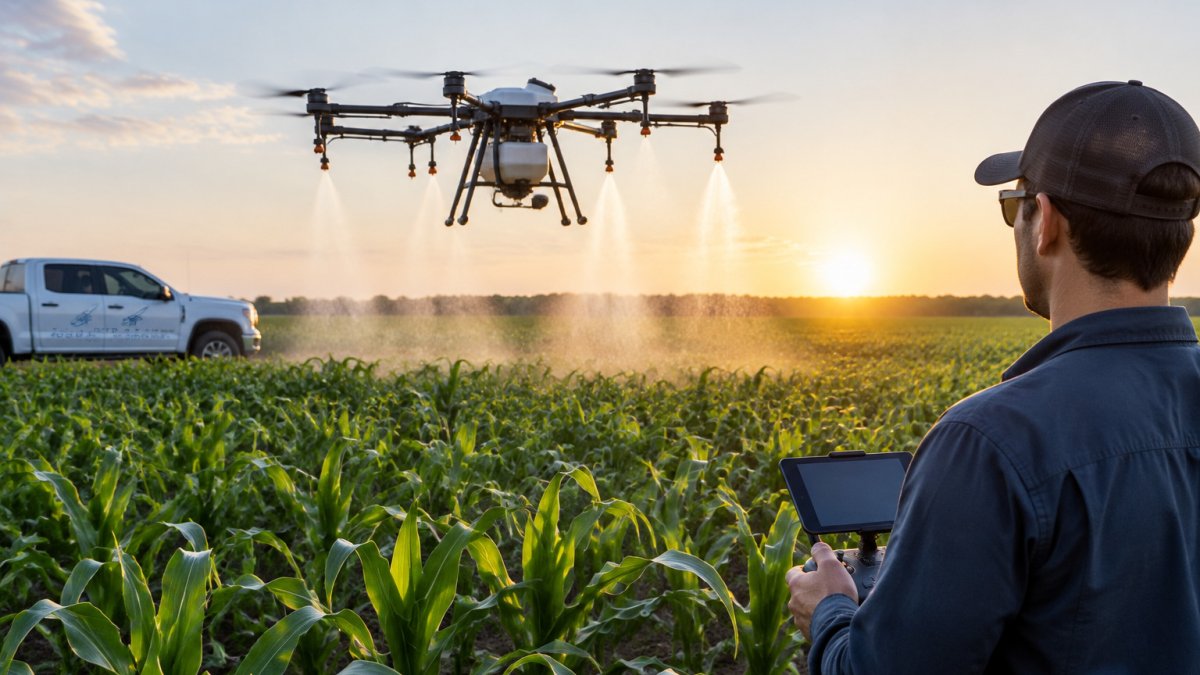
Wind speed is the most critical factor for safe and effective drone spraying. According to Kansas State University Extension (2026), wind speeds of 3-7 mph are suitable for most pesticide applications. Operating outside this range can lead to significant drift, which wastes product and risks damaging nearby crops.
Drone spraying corn requires careful planning because the height of the canopy changes how the wind moves around the plants. While some operators prefer calm days, research from University of Kentucky researchers shows that spray patterns can shift even at speeds of 5 mph or below.
- Keep wind speed between 3 and 7 mph
- Avoid spraying when gusts exceed 10 mph
- Check local wind direction relative to sensitive areas
Monitoring Temperature and Humidity for Spraying Corn
Temperature and humidity levels change how droplets behave once they leave the nozzle. The ideal temperature range for drone spraying corn is between 60°F and 85°F. Kansas State University Extension (2026) notes that these conditions help droplets reach the target area before they evaporate.
High heat often causes droplets to shrink and drift. If the air is too dry, liquid may evaporate before it hits the leaf surface. Always monitor these factors to ensure your application is effective and compliant with label requirements.
- Target temperatures of 60°F-85°F
- Watch for high humidity to prevent rapid evaporation
- Adjust spray volume if temperatures climb above 85°F
Identifying the Best Time of Day to Spray Corn Fungicide
Timing is everything when it comes to fungicide application in corn. The best time of day to spray is usually early morning, when winds are calm and temperatures are rising but still below 85°F.
The man is American.
Essential Drone Spraying Corn Application Checklist
Before any drone spraying mission begins, a strict checklist is used to protect assets and ensure the job is done right. The checklist below is used to prepare a field and coordinate with the grower before the drone arrives.
Two weeks to a few days before the flight
- Confirm the product, rate, and target pest or disease with the grower, and verify the product is labeled for aerial application on corn at that growth stage.
- Obtain the field map with boundaries, waterways, and any restricted zones, and confirm the grower has authorized access to every parcel and the launch area.
- Identify obstacles on and around the field: power lines, poles, trees, barns, irrigation equipment, and any tall structures near the flight path.
- Agree on water access and refill logistics, including where the tender or water source will sit and how many refills the field will need.
- Exchange emergency contacts and confirm who has authority to pause or stop the application.
The day before and the morning of the flight
- Walk or review the launch site: flat, accessible, clear of people, livestock, and vehicles, with a safe approach and departure path.
- Mark field boundaries and obstacle locations on the flight map, and set the spray boundary inside the field edge so the drone does not overspray ditches or roads.
- Verify wind speed and direction at the field, temperature, humidity, and inversion risk against the label limits.
- Calibrate the drone for the specific product and confirm nozzle and droplet size match the label and the wind conditions.
- Map the flight path and confirm overlap and coverage settings for the current canopy height.
- Clear the area of bystanders and livestock before takeoff, and confirm the grower or spotter is in position.
During and after the flight
- Monitor battery state, connectivity, and changing weather on every pass, and have a contingency plan for a low battery, lost link, or sudden wind shift.
- Record the conditions, product, rate, and area treated, and retain the application record as required.
Watch out: The most common failure is a field map that is accurate on paper but missing a wire, a pole, or a newly planted tree. Verify obstacles on site rather than trusting the map alone.
We help you understand how Drone Precision Spraying Benefits for Corn can improve your yields. If you need more technical help, our team explains How Drones Help With Variable Rate Application.
Managing Drift and Environmental Safety
Drift management is the primary goal of any responsible aerial application, and it is also where weather decisions become legal decisions. Product labels set the enforceable limits: many corn fungicide and insecticide labels specify a maximum wind speed for aerial application, required droplet size or nozzle type, and downwind buffer distances to sensitive areas such as waterways, residences, and pollinator habitat. Read the label before the flight, not after, because the label, not the operator's comfort level, defines the no-go line.
A practical go/no-go framework for corn spraying looks like this:
- Wind speed: Stay within the label range and within the 3-7 mph window most practitioners treat as the sweet spot. Treat sustained gusts above 10 mph as a stop condition unless the label and product formulation clearly allow more.
- Wind direction: Measure at the field, not at the nearest airport. A 5 mph wind blowing toward a sensitive area is a different mission than the same wind blowing into open corn.
- Temperature and humidity: High heat and low humidity shrink droplets before they reach the canopy. Low humidity combined with high temperature is a common trigger for evaporation-driven drift.
- Temperature inversion: Early morning is popular because winds are calm, but calm can also mean a stable inversion that traps fine droplets and carries them long distances. Watch for clear skies, very low wind, and a temperature that rises quickly after sunrise, that combination is a warning sign, not an invitation.
- Sensitive areas: Identify downwind residences, livestock, waterways, pollinator habitat, and neighboring specialty crops before takeoff, and set the buffer distance from the label rather than from habit.
Droplet size is the main lever inside those limits. Coarser droplets reduce off-target movement but can reduce canopy penetration in tall corn; finer droplets cover better but travel farther. Most practitioners match droplet size to the product and the wind, then verify coverage on the target leaves rather than assuming it.
Watch out: A calm morning can be the most deceptive window of the day. If the air is still and the forecast shows a rapid warm-up, confirm the inversion has broken before you load the tank.
Record the conditions at the time of application, wind speed and direction, temperature, humidity, and the buffer you used, because that record is what demonstrates the application stayed within the label if questions arise later.
Operators should follow these environmental guidelines to ensure safe and compliant drone spraying.
| Factor | Recommended Range | Note |
|---|---|---|
| Wind Speed | 3-7 mph | Avoid gusts exceeding 10 mph |
| Temperature | 60°F-85°F | High heat causes droplet shrinkage |
| Wind Direction | Field-specific | Measure at the field site |
| Inversion Risk | Monitor conditions | Calm air can indicate stable inversions |
Field Access and Obstacle Planning
Field access is often the biggest challenge for drone operations. Power lines, trees, and tall structures create hazards that require careful flight planning. We map these features before we arrive to ensure the drone avoids them during the flight path.
- Identify all power lines and tall trees
- Mark field boundaries clearly on your flight map
- Choose a flat, accessible launch site near the target area
- Clear the area of bystanders before takeoff
Booking Your Professional Drone Application
When you are ready to move forward, we are here to help. At Gods Eye Drone, our certified pilots provide aerial intelligence for your farm.
If you are ready to explore our agricultural services, reach out to contact our team for a quote. We also recommend reading our guide on what to ask before hiring a pilot to ensure you pick the right partner for your corn fields.
Managing drone spraying corn requires professional oversight and constant monitoring of the weather. We use the latest technology to ensure every application is precise and safe for your crops. Get started with Gods Eye Drone and improve your field efficiency.
Frequently Asked Questions
What is the ideal wind speed for drone spraying corn?
Research indicates that wind speeds between 3 and 7 mph are generally suitable for most pesticide applications, including herbicides and fungicides. It is critical to stay within the limits specified on the product label. Avoiding applications at wind speeds below 3 mph or above 10 mph is often recommended to prevent drift and ensure the spray pattern remains consistent over the target area. Always verify local conditions before launch.
How do temperature and humidity for spraying corn impact results?
Ambient temperatures between 60°F and 85°F are typically favorable for drone spraying corn. High heat and low humidity can cause droplets to evaporate before they reach the crop canopy, significantly reducing the effectiveness of the application. Monitoring these variables is a core part of professional flight planning to ensure the product reaches the target area rather than drifting away from the field.
What is the best time of day to spray corn fungicide?
The best time of day to spray corn fungicide is when wind and temperature conditions are most stable, often during early morning or late evening. These windows typically offer lower wind speeds and higher humidity, which help manage drift and improve coverage. During the day, thermal activity and shifting winds can compromise precision. Always check for temperature inversions before starting your drone spraying corn operation to ensure maximum efficacy and safety.