 ultimate-guide
Tethered Aerostat Communication Relay Benefits
Table of Contents
- What Tethered Aerostat Communication Relay Systems Deliver
- Operational Efficiency and Cost-Effectiveness
- Persistent Surveillance Systems and Real-Time Monitoring
- Payload Capacity and Sensor Integration
- Tethered Drone Communication Relay for Network Restoration
- Aerostat Deployment Logistics and Accelerated Launch
- Technical Limitations, Regulatory Requirements, and Maintenance
- Frequently Asked Questions
Last Updated: October 2, 2026
What Tethered Aerostat Communication Relay Systems Deliver
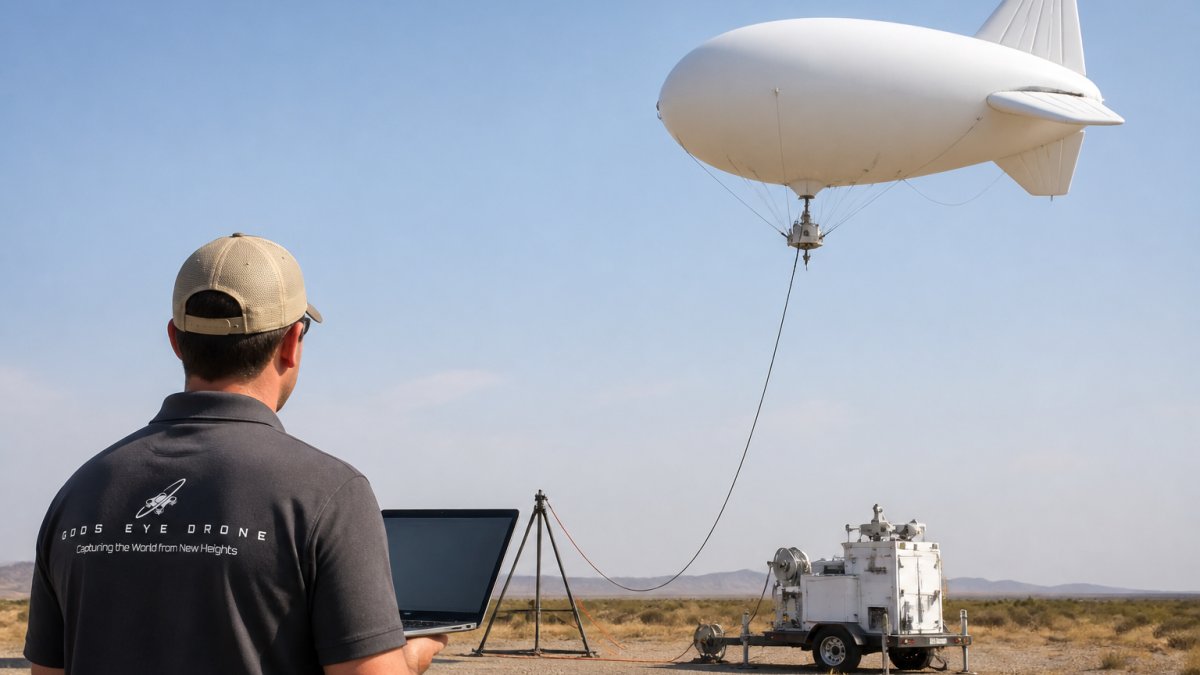
A tethered aerostat communication relay is an aerially deployed platform tethered to the ground via cable, equipped with communication equipment to extend network coverage, restore connectivity, or provide persistent surveillance.
Unlike conventional drones that must return for battery swaps, a tethered aerostat can remain aloft for weeks or months, providing uninterrupted service.
The cable provides both power and data connectivity, eliminating battery dependency while ensuring secure communication channels. For organizations supporting search and rescue and critical infrastructure inspections, this combination transforms what's possible at altitude.
Operational Efficiency and Cost-Effectiveness
A single tethered aerostat communication relay can replace dozens of drone sorties, eliminating pilot time, battery cycles, and maintenance. For continuous coverage over days or weeks, the economics strongly favor persistent systems.
Deployment typically takes 30-45 minutes from transport to full operational status.
Power delivery through the tether eliminates battery degradation, the largest expense driver in drone operations. Maintenance becomes predictable, scheduled tasks rather than reactive repairs, shifting costs from per-flight to amortized platform expenses.
A properly designed tethered system maintains position in winds that ground most drones, improving mission success rates and reducing backup system needs.
Persistent Surveillance Systems and Real-Time Monitoring
A tethered aerostat communication relay can remain at altitude for 24-72 hours or longer, providing continuous real-time monitoring without coverage gaps. For search and rescue, border surveillance, critical infrastructure protection, or disaster response, this uninterrupted presence fundamentally changes operational capability.
Altitude Optimization and Line-of-Sight Coverage
Tethered systems typically operate at 500-1,500 feet altitude. At 500 feet, a 60-degree field-of-view sensor covers approximately 1,200 feet of ground; at 1,000 feet, 2,400 feet. This range provides sufficient detail for identifying personnel, vehicles, or infrastructure while maintaining line-of-sight communication with ground stations up to 15-20 miles away.
Terrain masking from hills, buildings, or vegetation is significantly mitigated at these altitudes. A platform at 1,000 feet maintains communication with ground stations in valleys or behind ridgelines that would block signals from 100-foot drones, particularly valuable in mountainous or urban environments.
Earth Curvature and Signal Propagation
At ground level, the radio horizon extends roughly 4-5 miles; at 1,000 feet altitude, approximately 40 miles for UHF/VHF systems. A single tethered relay covers areas requiring multiple ground-based repeaters or drone sorties. A system at 1,500 feet achieves approximately 48 miles radio horizon, assuming flat terrain and adequate antenna gain.
Real-Time Data Streaming and Latency Performance
A tethered system streams sensor data continuously to the ground control station via wired tether, eliminating wireless latency and achieving sub-100-millisecond transmission. This near-real-time feed enables emergency response teams to make decisions based on current conditions.
For search and rescue, a thermal imaging sensor can detect a missing person's heat signature and transmit coordinates within seconds. For border surveillance, continuous monitoring detects activity without gaps from drone battery swaps.
Tether bandwidth typically supports 10-100 Mbps, accommodating simultaneous transmission of high-definition video, thermal imagery, and signal intelligence without compression artifacts.
Sensor Stability and Data Quality
The stability of a tethered platform directly improves sensor performance. Wind-induced motion on a properly designed system is minimal, typically less than 2-3 feet of oscillation even in 20 mph winds.
For thermal imaging, platform stability is particularly valuable. Thermal sensors are sensitive to platform motion; a stable platform produces cleaner thermal signatures with less noise.
Multispectral and hyperspectral sensors also benefit from platform stability. Agricultural monitoring, environmental assessment, and infrastructure condition evaluation all rely on consistent sensor orientation and minimal motion artifacts.
Integration with Existing Sensor Suites
Tethered systems accommodate multiple sensors operating simultaneously from the stable platform. A typical deployment might include thermal cameras for detection, optical imaging for identification, and communication relay equipment for network restoration, all operating together without interference. This sensor fusion capability enables richer situational awareness than single-sensor platforms provide.
The power delivery through the tether enables high-power sensors that battery-dependent drones cannot sustain. Sophisticated radar systems, high-output communication relays, and intensive processing equipment all become feasible when power constraints disappear.
Payload Capacity and Sensor Integration
Tethered aerostats support substantial payload capacity, typically 50 to 200+ pounds depending on platform size and tether specifications.
The stability of a tethered platform matters for sensor performance. Wind-induced motion is minimal compared to free-flying systems, producing sharper imagery and more reliable data collection.
Sensor integration flexibility is a key advantage. You can outfit the same platform with different payloads depending on mission requirements.
Power delivery through the tether enables high-power sensors that battery-dependent drones cannot sustain. Sophisticated radar systems, high-output communication relays, and intensive processing equipment all become feasible when power constraints disappear.
Tethered Drone Communication Relay for Network Restoration
When terrestrial infrastructure fails, downed cell towers, damaged fiber lines, network congestion during emergencies, a tethered aerostat communication relay restores connectivity within minutes.
Deployment speed is critical in disaster response. A ground crew can position the system and activate communication relay functions faster than traditional infrastructure repair.
The tethered cable carries both power and data, eliminating the latency and reliability issues that plague wireless backhaul solutions.
Network redundancy improves overall system resilience. A tethered relay provides an independent communication path that bypasses damaged infrastructure, creating backup coverage that persists as long as the platform remains aloft.
Aerostat Deployment Logistics and Accelerated Launch
Rapid deployment begins with simple logistics.
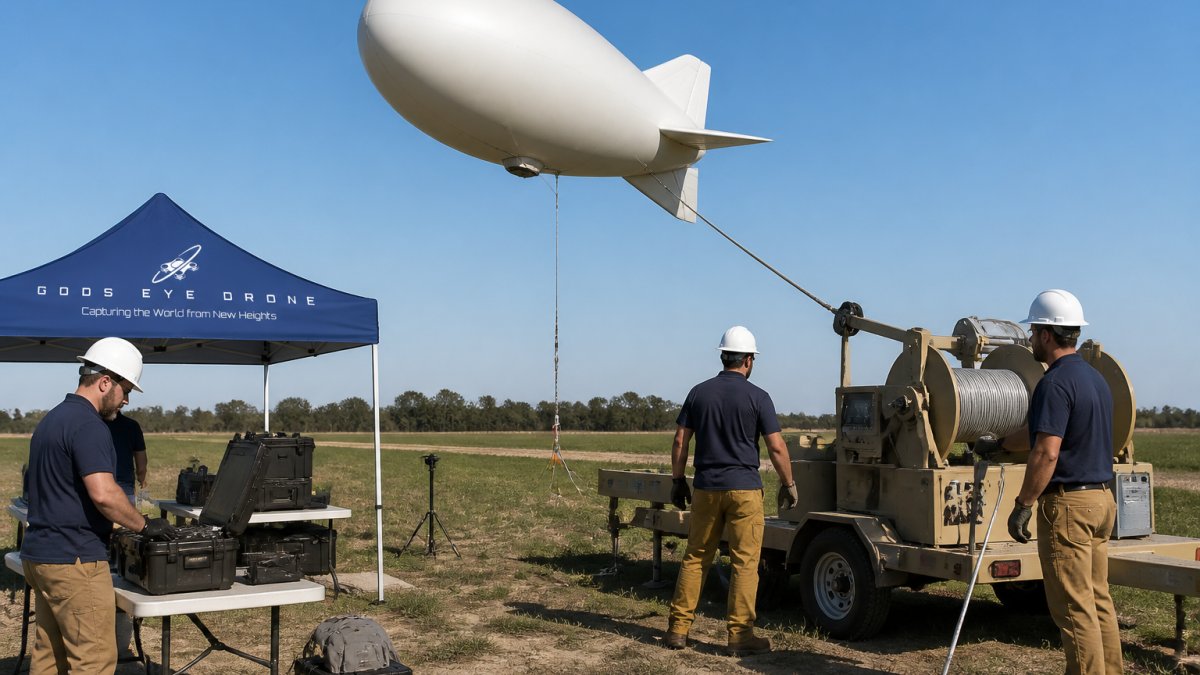
Accelerated launch procedures prioritize speed. Inflation takes 15-20 minutes for helium-filled systems, followed by tether attachment and control station setup.
Ground crew requirements are minimal. A two-person team can manage deployment and basic operations, though larger teams may be assigned for complex missions.
Tether management systems automate many deployment functions. Motorized winches control ascent and descent, while tension monitoring systems maintain safe operating parameters.
Technical Limitations, Regulatory Requirements, and Maintenance
Tethered aerostat systems operate within well-defined technical and regulatory boundaries that operators must navigate before deployment. Understanding these constraints is essential for mission planning and legal compliance.
Wind and Environmental Operating Limits
Tethered systems face specific wind speed thresholds that vary by platform design and tether specifications. Most commercial systems operate safely in winds up to 20-30 mph; beyond 35 mph, retrieval becomes mandatory. Icing conditions present a secondary constraint, ice accumulation on the aerostat envelope and tether can increase weight and drag, forcing descent even in moderate winds. Temperature extremes also matter: helium-filled aerostats lose buoyancy in extreme cold, while UV exposure degrades envelope materials over months of continuous outdoor exposure.
FAA Airspace Coordination and NOTAM Requirements
Operating a tethered aerostat above 200 feet requires coordination with the Federal Aviation Administration. Systems operating in controlled airspace (Class B, C, or D) near airports must file a Notice to Airmen (NOTAM) at least 24 hours before deployment. The FAA's Part 101 regulations govern tethered free balloons and aerostats; systems exceeding 500 feet in altitude or operating near airports face additional restrictions. For operations in uncontrolled airspace (Class E or G), NOTAM filing is still required if the system exceeds 500 feet above ground level.
Data Security and Encryption Protocols
As communication relays, tethered systems transmit sensitive data, surveillance feeds, emergency response coordination, or critical infrastructure monitoring, that requires protection against interception. Military and law enforcement applications demand secure channels meeting Department of Defense standards. Implementing AES-256 encryption for data links, secure authentication protocols, and frequency-hopping spread spectrum (FHSS) techniques prevents unauthorized access. Ground control stations should operate on isolated networks with VPN protection when transmitting sensitive information. Regular security audits and firmware updates address emerging vulnerabilities. For civilian emergency response, encryption standards may be less stringent but should still prevent casual interception of first-responder communications.
Maintenance Intervals and Lifecycle Planning
Tethered systems require scheduled maintenance to sustain reliability. Tether inspection occurs every 100 operational hours or quarterly, whichever comes first; visual inspection for fraying, corrosion, or embedded debris prevents catastrophic failure. Aerostat envelope condition, checking for gas leakage, UV damage, or material degradation, requires monthly assessment during active deployment and before seasonal storage. Winch and motorized systems need lubrication and mechanical inspection every 200 hours. Communication equipment undergoes functional testing before each deployment and after any weather event. Battery backup systems (if used for ground control) require load testing quarterly.
Operator Training and Competency Requirements
Personnel operating tethered systems must understand tether handling, emergency descent procedures, and equipment troubleshooting. Recommended training covers: tether attachment and tension monitoring, winch operation and safety interlocks, aerostat inflation and envelope inspection, weather assessment and retrieval decision-making, and emergency descent under power loss. Many operators require initial certification through manufacturer-provided training (typically 2-3 days) followed by annual refresher training. Ground crew should also understand communication system operation, payload integration, and basic electrical troubleshooting. Operators in remote or austere environments benefit from advanced training in field repairs and improvised problem-solving.
Frequently Asked Questions
What is a tethered aerostat communication relay system?
A tethered aerostat is a moored, lighter-than-air platform (blimp or balloon) tethered to the ground by a cable that houses power lines, data links, and communications equipment. Unlike drones, it maintains station over a fixed location indefinitely, providing persistent surveillance, signal relay, and network restoration. The tether supplies continuous power and data connectivity, enabling 24/7 operations without battery constraints. These systems are widely used by emergency response teams, border security, and infrastructure monitoring operations.
How does a tethered aerostat communication relay maintain a persistent signal?
The tether cable integrates power delivery and fiber-optic or copper data lines, eliminating reliance on onboard batteries. This continuous power supply allows the aerostat to operate indefinitely at altitude, maintaining line-of-sight with ground stations and relay points. The elevated position, typically 300 to 1,500 feet, overcomes terrain masking and earth curvature effects, extending signal propagation range significantly. Real-time monitoring and automated systems ensure uninterrupted signal relay for 4G/LTE network restoration and tactical communications during emergencies.
What operational advantages do tethered aerostats offer over traditional drones?
Tethered aerostats provide high-endurance flight performance without battery depletion, enabling persistent surveillance for days or weeks. They carry larger payloads than comparable drones, supporting multiple sensors, thermal imaging, and communication equipment simultaneously. Deployment is faster, minutes rather than hours, making them ideal for emergency response. Operating costs are lower over extended missions because they don't require frequent battery swaps or pilot rotation. They also tolerate adverse weather conditions better than smaller drones and provide more stable platforms for sensor integration.
What are the main regulatory and environmental challenges with tethered aerostat systems?
Tethered aerostats require Federal Aviation Administration (FAA) airspace authorization under Part 107 regulations, with restrictions on altitude, proximity to airports, and flight corridors. Environmental resilience varies, high winds above 30 mph typically ground operations, and lightning risk requires immediate deployment protocols. Data security protocols must meet operational security standards, especially for law enforcement and emergency response missions. Maintenance lifecycle costs include cable inspection, tether replacement, and envelope repair. Technical training for ground crews is essential for safe operation and rapid deployment during critical incidents.