 ultimate-guide
Scaling Commercial Drone Operations: 2026 Enterprise Guide
Table of Contents
- Building the Program Foundation Before You Scale
- Drone Fleet Management Software: The Backbone of Scaling Drone Operations
- FAA Part 107 Compliance for Fleets: Governance at Scale
- Automated Drone Inspection Workflows That Cut Manual Effort
- Hardware Lifecycle and Vendor-Agnostic Fleet Strategy
- Cybersecurity and Data Privacy at Enterprise Scale
- Change Management, Insurance, and Cross-Departmental Buy-In
- Frequently Asked Questions
Last Updated: September 16, 2026
Building the Program Foundation Before You Scale
Scaling commercial drone operations for large enterprises fails for a predictable reason: teams buy aircraft before they build the systems that govern them. A single pilot flying one site is a hobby with paperwork. Fifty aircraft across twelve states is an aviation program, and it needs the same discipline an airline applies to fleet oversight.
The gap between those two states is where most enterprise drone initiatives stall. Gods Eye Drone has watched this pattern from the service side, and the organizations that scale successfully share one trait: they treat the drone program as infrastructure, not equipment.
Scaling drone operations is the process of expanding an aerial program from isolated flights to a governed, repeatable, enterprise-wide capability. It requires four foundations before the first additional aircraft arrives:
- A written governance framework naming who owns the program, who approves flights, and who audits records
- A defined set of program goals tied to business outcomes, not flight counts
- Standard operating procedures covering pre-flight, in-flight, and post-flight activity
- A documented risk mitigation approach that satisfies legal, safety, and insurance reviewers
Skip any one of these and the program hits a ceiling. The FAA's guidance on operating multiple small unmanned aircraft makes clear that the operator, not the pilot alone, carries responsibility for compliance across every aircraft in the fleet.
Drone Fleet Management Software: The Backbone of Scaling Drone Operations
Drone fleet management software is the platform layer that tracks aircraft, pilots, missions, maintenance, and compliance records in one system of record. Without it, a growing fleet becomes a spreadsheet problem that no one can audit, and an audit is exactly what regulators, insurers, and enterprise procurement will eventually demand.
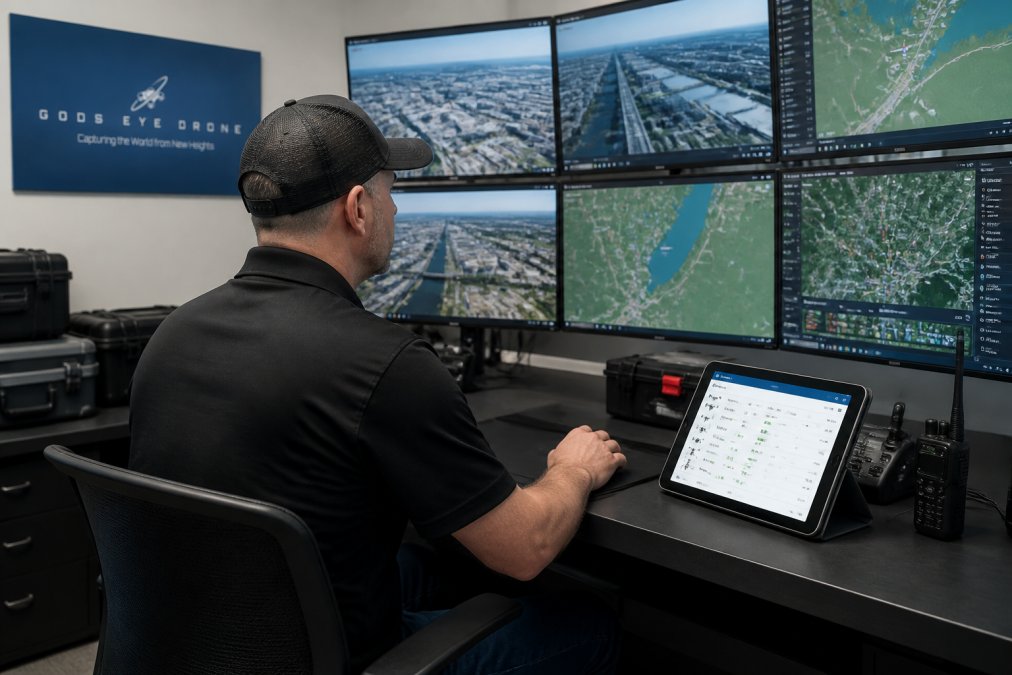
The mistake most large enterprises make is treating this as a procurement decision. It is an architecture decision. The platform you choose in month three determines what you can prove in year three, and migrating a live fleet off a platform mid-scale is expensive enough that most programs simply tolerate the wrong tool rather than move.
The Data Model That Actually Matters
A fleet platform is only as good as the entities it can relate to one another. At minimum, the system of record should link five objects: the aircraft (serial number, registration, firmware version, flight hours), the battery (cycle count, charge history, assigned aircraft), the pilot (certificate number, currency date, site authorizations), the mission (site, objective, airspace authorization, aircraft and pilot assigned), and the record (logbook entry, imagery set, maintenance event, incident report).
Cloud-Based Management and Telemetry
Cloud-based management centralizes telemetry from every aircraft so operations teams can see battery health, flight hours, and location history in real time. Remote monitoring turns a distributed fleet into a single operational picture, which matters when aircraft are spread across job sites.
Automated Mission Planning and Asset Tracking
Automated mission planning lets a program manager build a repeatable flight profile once and deploy it across sites. Asset tracking ties each aircraft to its maintenance schedule, registration, and pilot assignment. Together they cut the administrative load that otherwise grows linearly with fleet size.
Integration With Enterprise Systems
Fleet software that lives in isolation creates a second system of record, which is the opposite of the goal. The platform should push completed mission data into the systems the enterprise already trusts: work order and asset management platforms, GIS, and the enterprise identity provider for single sign-on and role-based access.
FAA Part 107 Compliance for Fleets: Governance at Scale
FAA Part 107 compliance for fleets means applying the same certification, training, and recordkeeping standards to every pilot and aircraft in the program, not just the first one. The rules do not change as you grow; your ability to prove compliance does.
Pilot Certification and Training Workflows
Every remote pilot in command needs a current Part 107 certificate, and the operator needs a way to verify it. A training workflow should cover initial certification, recurrent knowledge checks, site-specific briefings, and currency tracking. When a program runs dozens of pilots, manual tracking breaks down fast.
Safety Management System and Risk Mitigation
A safety management system gives the program a formal method for identifying hazards, assessing risk, and correcting problems before they cause an incident. Programs that operate beyond visual line of sight or over people need this discipline most, and it is often what insurers ask to see first.
Airspace Authorizations and Waivers at Fleet Scale
Part 107 flights in controlled airspace require prior authorization, and the mechanism most operators use is the FAA's Low Altitude Authorization and Notification Capability, commonly known as LAANC. LAANC provides near-real-time authorization in participating areas, but it is not universal, and it does not cover every operation.
Recordkeeping That Survives an Audit
A defensible record set includes, at minimum: the pilot's certificate and currency status, the pre-flight inspection record, the airspace authorization or waiver under which the flight operated, the flight log with date, time, location, and duration, and any incident or anomaly report. Retention periods vary by enterprise and by insurer, so set a policy and enforce it uniformly.
Automated Drone Inspection Workflows That Cut Manual Effort
Automated drone inspection workflows replace ad hoc flights with scheduled, repeatable missions that feed directly into a data pipeline. The efficiency gain comes from removing the manual steps between flight and decision.
Data Processing Pipeline and Enterprise Integration
A data processing pipeline moves imagery from the aircraft to processed output without human handling at each stage. Enterprise integration connects that output to the systems teams already use, so inspection results land in the asset management or GIS platform rather than a shared drive.
Hardware Lifecycle and Vendor-Agnostic Fleet Strategy
Vendor lock-in is the quiet cost of drone programs. Buying every aircraft from one manufacturer simplifies support until that manufacturer changes its software terms, discontinues a model, or prices replacement parts above what the program can justify.
Cybersecurity and Data Privacy at Enterprise Scale
Aerial imagery is sensitive data. It can capture facility layouts, security arrangements, and personal information, which means the drone program inherits the same data security obligations as any other enterprise system.
Change Management, Insurance, and Cross-Departmental Buy-In
The technical work is often the easy part. The harder work is convincing operations, legal, safety, and finance that the program deserves budget and access.
| Scaling Challenge | Common Failure | Practical Fix |
|---|---|---|
| Governance | No named program owner | Assign an accountable program manager |
| Compliance | Manual pilot record tracking | Centralize certification and currency in fleet software |
| Data | Imagery stranded on local drives | Build the processing pipeline before volume grows |
| Hardware | Locked to one manufacturer | Track assets and retire on schedule |
| Risk | Insurance reviewed after expansion | Involve the carrier before scaling |
Frequently Asked Questions
What are the key regulatory requirements for scaling enterprise drone fleets?
At scale, you need more than individual pilot certification. The FAA requires Part 107 Remote Pilot certificates for every pilot, but enterprise fleets also need a formal safety management system, documented standard operating procedures, and waivers for operations like beyond visual line of sight or night flights. Larger programs often pursue a Part 135 certificate or operate under a Section 44807 exemption. A governance framework that tracks pilot currency, aircraft registration, and incident reporting keeps the entire fleet compliant.
How do you manage data processing at scale for commercial drone operations?
Scaling drone operations generates massive data volumes. A structured data processing pipeline starts with automated uploads from the field to cloud storage, then routes imagery through processing software for orthomosaics, 3D models, or thermal analysis. Enterprise integration with platforms your teams already use (GIS systems, project management tools) prevents data from sitting unused. Automated drone inspection workflows tag and deliver results directly to the relevant department, cutting the manual sorting that slows large programs.
What is the 1:1 rule for drones in enterprise settings?
The 1:1 rule refers to the FAA requirement that each drone in flight has one Remote Pilot in Command actively controlling it. For enterprise fleets, this limits how many aircraft you can operate simultaneously unless you obtain waivers for autonomous deployment or drone-in-a-box systems. Understanding this constraint shapes your scaling plan: it determines crew ratios, shift scheduling, and whether you invest in automation that lets one pilot oversee multiple aircraft through cloud-based management.
How do you integrate drone-in-a-box technology into existing workflows?
Drone-in-a-box systems allow autonomous deployment from a fixed dock, with automated mission planning and remote monitoring. Integration starts by identifying repeatable inspection routes (perimeter security, asset monitoring, site progress) that fit a dock location. Connect the system's API to your drone fleet management software so flight data, telemetry, and deliverables flow into your existing enterprise integration layer. Pilot certification requirements still apply for oversight, but the dock reduces on-site labor and enables scheduled flights without a crew present.
Scaling a drone program is a systems problem, and the systems are easiest to build before the pressure hits. Gods Eye Drone works with organizations that need certified pilots, precise aerial inspections, and FLIR-equipped thermal imaging for infrastructure and emergency response work, backed by a veteran-owned team that treats operational readiness as the baseline. Get started with Gods Eye Drone and build the aerial capability your operation can actually rely on.