 comparison
Are Drone Services Worth It for Municipal Search and Rescue?
Table of Contents
- The Real Cost of Professional Drone Services for Municipal Search and Rescue
- FLIR Thermal Imaging for Search and Rescue: Why It Changes the Game
- Outsourcing Drone Services vs In-House Drone Teams: A Cost-Benefit Analysis
- FAA Part 107 Requirements for Public Safety: Compliance Without the Headache
- Liability and Risk Management for Local Governments
- Long-Term Maintenance and Lifecycle Costs of Drone Programs
- Pilot Retention and Staffing Models for Municipal Drone Programs
- Frequently Asked Questions
Last Updated: September 20, 2026
The Real Cost of Professional Drone Services for Municipal Search and Rescue
Whether professional drone services for search and rescue are worth the investment for local municipalities comes down to a simple trade-off: capital expense versus operational capability. This guide from Gods Eye Drone breaks down the costs, funding paths, and staffing realities that determine whether an unmanned aerial systems program pays off.
| Cost Category | Typical Timing | What Drives It |
|---|---|---|
| Aircraft and sensors | One-time | Airframe class, thermal payload |
| Pilot certification | One-time per pilot | Part 107 training and testing |
| Batteries and consumables | Recurring | Flight hours, mission tempo |
| Maintenance and repair | Recurring | Crash history, environment |
| Insurance and liability | Recurring | Coverage limits, fleet size |
| Training and recertification | Recurring | Staff turnover |
Breaking Down Initial and Ongoing Expenses
Upfront costs center on the aircraft, thermal payload, spare batteries, and pilot certification. Ongoing costs are where budgets surprise people: battery replacement, sensor calibration, repairs, insurance, and recurring training compound over a program's life.
Funding Options: Grants and Budget Reallocation
Grant funding is the most common path for agencies that cannot absorb a drone program into the existing budget. Federal homeland security and emergency management grants, state public safety grants, and local reallocation from equipment reserves are the usual sources.
FLIR Thermal Imaging for Search and Rescue: Why It Changes the Game
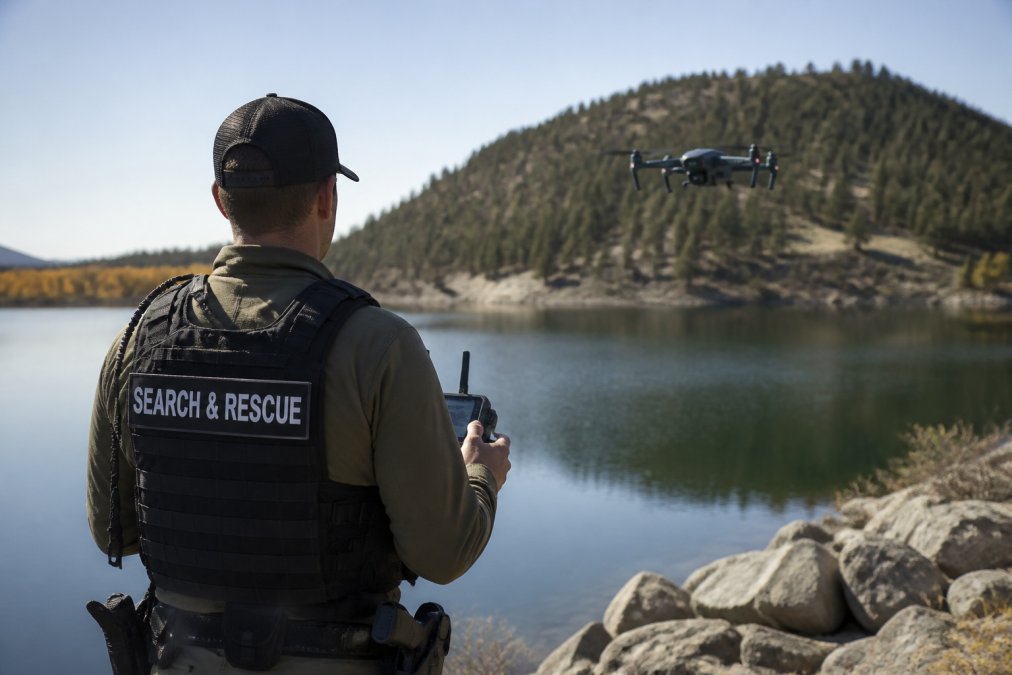
FLIR thermal imaging separates a useful search and rescue drone from an expensive toy. Thermal sensors detect body heat against cooler ground, so a missing person can be located at night, through light vegetation, and in conditions where visual cameras fail.
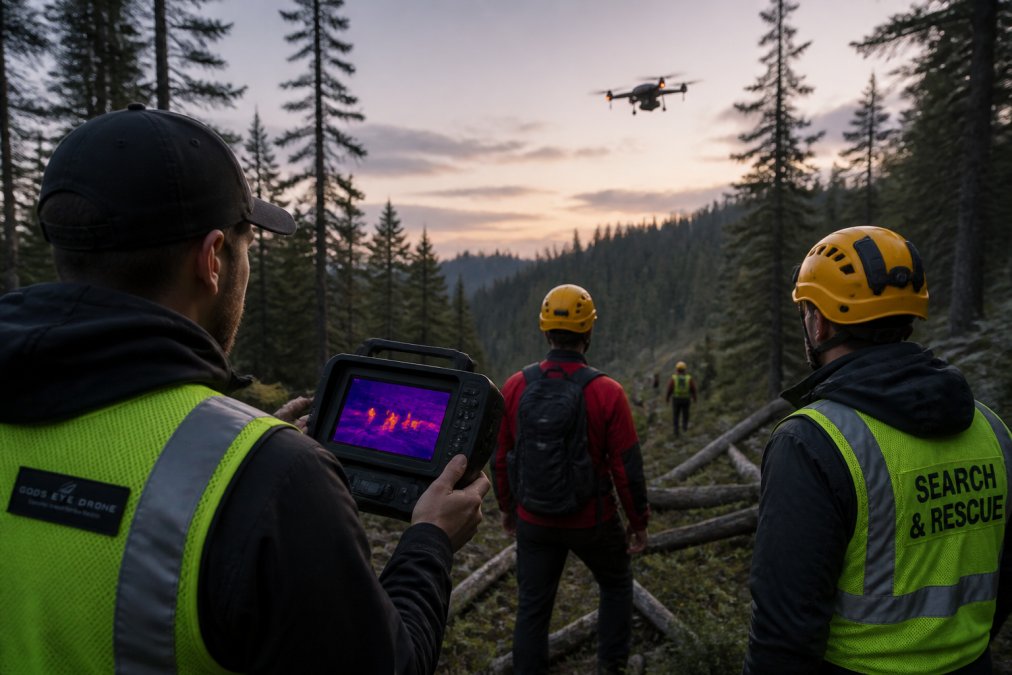
How Thermal Imaging Locates Missing Persons Faster
A thermal-equipped drone flying a structured search pattern can scan large areas in minutes. The operator watches a live heat-signature feed while the aircraft covers grid lines that would take ground teams far longer on foot.
Outsourcing Drone Services vs In-House Drone Teams: A Cost-Benefit Analysis
Outsourcing drone services vs in-house drone teams shapes long-term cost more than any other decision, and most municipal guides handle it with a bullet list instead of a model. The right answer depends on three variables: annual mission volume, whether a staff member can hold a Part 107 certificate, and how much of your response footprint is time-critical.
The Cost Structure of Each Model
An in-house program carries fixed costs that exist whether you fly once a month or once a week:
- Aircraft and thermal payload, one-time capital outlay, plus a spare airframe if you cannot tolerate downtime
- Pilot certification, one-time per pilot for the Part 107 knowledge test and recurrent currency
- Batteries and consumables, recurring, driven by flight hours and mission tempo
- Maintenance, calibration, and repair, recurring, driven by crash history and environment
- Aviation liability insurance, recurring, driven by coverage limits and fleet size
- Recurring training and recertification, recurring, driven by staff turnover
The Break-Even Question
The practical break-even is not a dollar figure but a mission-frequency threshold. Below a certain number of callouts per year, fixed ownership costs (insurance, currency flights, battery replacement, calibration) spread across too few missions to beat a per-mission contract rate. Above it, ownership wins because the marginal cost of the next flight is low.
When to Hire a Professional Drone Company
Hiring makes sense when:
- Call volume is low or seasonal
- No staff member can commit to ongoing Part 107 currency and training
- The mission requires specialized sensors the department does not own
- The agency needs documented liability coverage without adding headcount
- Response is needed in a jurisdiction where the department has no aviation program at all
A professional provider brings certified pilots, maintained equipment, and liability coverage as a contractual matter. For agencies that need thermal imaging and situational awareness on demand, FAA Part 107 overview certified operators like Gods Eye Drone provide FLIR-equipped aircraft and experienced pilots without the overhead of fleet ownership.
Building an Internal Program: Pros and Cons
An internal team gives you immediate availability, direct control over flight data, and integration with existing incident command. The trade-offs are real: staffing, training, maintenance, and insurance become your responsibility, and a single pilot departure can ground the program.
- Pros: Faster response, control over data, no per-mission fees, integration with incident command
- Cons: Upfront cost, ongoing training burden, pilot turnover risk, insurance and maintenance overhead
- Best fit: Departments with frequent call volume and stable staffing
The Hybrid Model Most Agencies Actually Land On
The binary framing of "outsource or build" misses the model that fits many municipalities: own a basic airframe and thermal payload for routine response, and contract a professional provider for surge incidents, wide-area searches, and missions requiring sensors you do not own. This keeps fixed costs low while preserving specialized capability when a search runs long or spans jurisdictions.
FAA Part 107 Requirements for Public Safety: Compliance Without the Headache
FAA Part 107 requirements for public safety govern nearly all drone operations, including search and rescue. Pilots must hold a remote pilot certificate, aircraft must be registered, and operations must follow altitude, visibility, and airspace rules unless a waiver or exemption applies.
Liability and Risk Management for Local Governments
Liability and risk management is where many drone programs quietly fail. A crash over private property, a data breach from captured footage, or an injury during launch all create exposure the department must plan for in advance.
Long-Term Maintenance and Lifecycle Costs of Drone Programs
Most municipal drone budgets stop at the purchase order. This section fills that gap with the total cost of ownership (TCO) over a program's life, what a finance officer actually needs to approve and sustain a search and rescue capability.
The Lifecycle Cost Categories
A realistic TCO model tracks six recurring categories alongside the initial capital outlay:
- Batteries, the highest-frequency replacement item. Capacity fades with charge cycles, and a battery that no longer holds enough flight time for a full search pattern is a liability, not an asset.
- Propellers and airframe components, low unit cost, high replacement frequency, especially after hard landings or operations in brush and debris.
- Gimbal and camera service, drift and vibration degrade image quality; thermal sensors need periodic calibration to keep temperature readings meaningful.
- Software and data subscriptions, mapping, flight-logging, and evidence-management platforms typically carry recurring license fees.
- Insurance, aviation liability coverage is a recurring premium, not a one-time purchase.
- Training and recertification, recurring, and directly tied to staff turnover.
Replacement Triggers, Not Calendar Dates
Fleet management means tracking every component, not just the aircraft. Departments that log flight hours, battery cycles, and repair history catch failures before a mission. Those that do not discover problems mid-search.
- Replace a battery when its usable flight time drops below the duration of your standard search pattern
- Service the gimbal on a fixed interval or after any hard landing
- Recalibrate the thermal sensor on a schedule and after any impact
- Retire an airframe when repair cost approaches replacement cost
Budgeting the Lifecycle
A realistic lifecycle plan assumes replacement of batteries and minor components well before the airframe itself, spreading those costs across budget cycles rather than absorbing them in one year. Departments that plan three to five years of consumables and training avoid the mid-cycle funding scramble that stalls small programs.
Pilot Retention and Staffing Models for Municipal Drone Programs
Pilot retention is the quiet threat to any internal program. Certified remote pilots are in demand, and a trained public safety pilot who leaves takes institutional knowledge, currency, and often the willingness to fly.
Frequently Asked Questions
What is the most lucrative drone business?
While profitability varies, specialized services like search and rescue for municipalities can be lucrative due to ongoing contracts and grants. Public safety agencies often have dedicated budgets for emergency response technology, and professional drone services can secure recurring revenue through retainer agreements. Other profitable niches include infrastructure inspections and agricultural monitoring, but search and rescue offers the added benefit of community impact and potential grant funding.
How much does a search and rescue drone cost?
Costs vary widely based on capabilities. For municipalities, outsourcing to a professional service eliminates upfront equipment costs and provides access to high-end drones without capital expenditure. Pricing depends on the specific equipment and service level required, so it's best to request a quote from a professional provider.
Do local municipalities need to own drones or hire professional services?
It depends on call volume and budget. Owning drones requires upfront investment, maintenance, insurance, and trained pilots. Hiring professional services offers flexibility and access to advanced technology without the overhead. Many municipalities start by outsourcing to test the waters and then transition to an in-house team as demand grows. A hybrid approach, where you own basic equipment but hire specialists for complex missions, can also be effective.
How do FAA regulations impact the use of drones in municipal search and rescue?
FAA Part 107 requires remote pilots to obtain a certificate and follow operational rules, such as flying within visual line of sight or obtaining waivers for beyond visual line of sight operations. For public safety agencies, there are provisions for emergency situations, but compliance is still necessary. Working with a certified drone service ensures all missions are conducted legally and safely, reducing liability for the municipality.