 listicle
Kansas Landscape Photography: Rocky Mountain Alternative Guide
Table of Contents
- Why Kansas Landscape Photography Rivals Rocky Mountain Destinations
- Flint Hills Photography: The Heart of Kansas Landscapes
- Monument Rocks and Geological Formations: Kansas's Hidden Gems
- Unique Photography Spots Kansas Offers Beyond Mountains
- Technical Gear Guide for Big Sky Photography in Kansas
- Kansas Photography Workshops and Learning Opportunities
- Best Times of Day and Seasonal Considerations for Kansas Photography
- Monetizing Your Kansas Landscape Photography Work
- Frequently Asked Questions
Kansas Landscape Photography: Rocky Mountain Alternative Guide
Last Updated: July 26, 2026
When photographers think of dramatic mountain vistas, they typically imagine the Rocky Mountains. But a rocky mountain photography alternative for kansas exists, and it's closer, more accessible, and increasingly recognized by serious landscape photographers as equally compelling. At Gods Eye Drone, we've documented countless Kansas landscapes that rival anything you'll find in Colorado or Wyoming.
The Flint Hills, Monument Rocks, and the vast grasslands of western Kansas offer something the Rockies don't: unobstructed, endless horizons with light that transforms throughout the day in ways mountain valleys simply cannot replicate. Below, we'll show you exactly how to approach Kansas landscape photography with the same technical rigor and artistic vision you'd bring to mountain work.
Why Kansas Landscape Photography Rivals Rocky Mountain Destinations
Mountains offer verticality and geological drama. Kansas offers the big sky advantage.
The Flint Hills and western Kansas landscapes deliver unobstructed light paths that create photographic conditions mountain photographers chase for weeks. A single golden hour in the Flint Hills can produce 50+ usable compositions. Mountain valleys often compress light and limit the window for clean shots to 20-30 minutes. Kansas light stays clean and directional for 90+ minutes, especially during spring and fall.
Accessibility matters more than photographers admit. Monument Rocks sits 90 minutes from the nearest major town. Most Rocky Mountain destinations require 2-4 hour drives from trailheads, plus hiking in variable conditions. Kansas locations are accessible via paved roads, often from a vehicle, which means you can scout, shoot, and iterate faster.
The desolate beauty of Kansas landscapes carries a different emotional weight than mountain grandeur. Where mountains command awe through scale, Kansas prairie commands it through emptiness, a compositional challenge that forces stronger visual storytelling.
Flint Hills Photography: The Heart of Kansas Landscapes
The Flint Hills represent the largest unbroken tallgrass prairie ecosystem remaining in North America, stretching across roughly 4,000 square miles of rolling terrain. For landscape photographers, this translates to one of the most photographically diverse regions in the central United States.
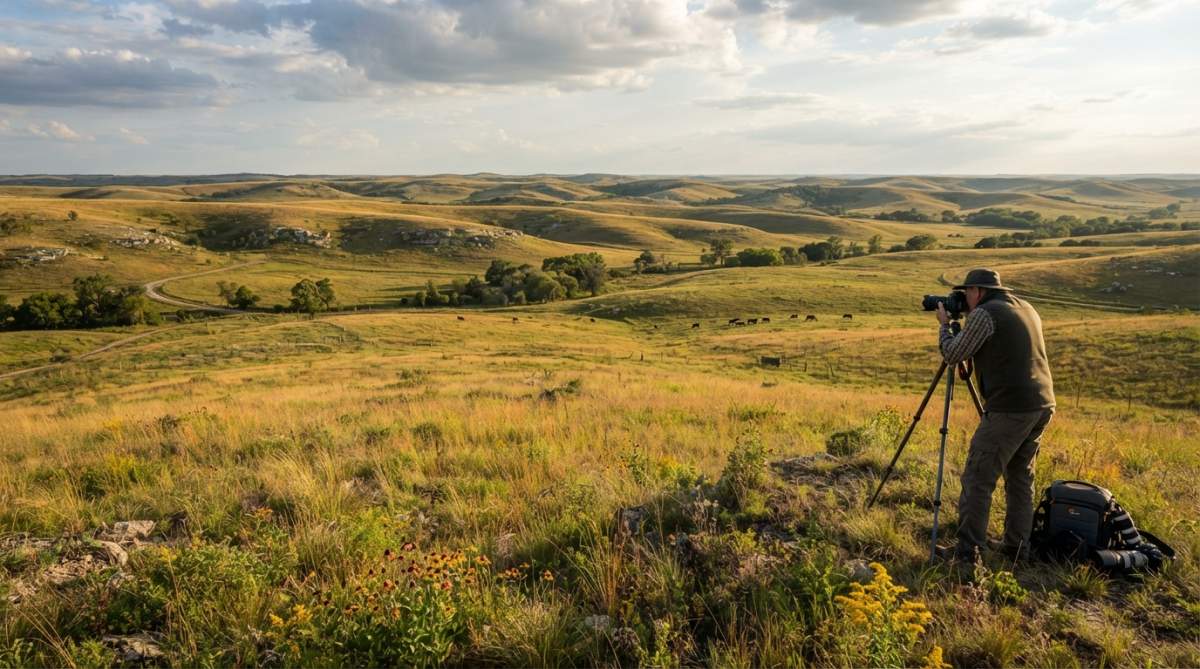
The Tallgrass Prairie National Preserve near Strong City and the adjacent Flint Hills National Scenic Byway form the backbone of accessible Flint Hills photography. The preserve offers over 40 miles of hiking trails through diverse prairie landscapes. The scenic byway connects multiple vantage points, allowing photographers to work multiple compositions in a single day without extensive hiking.
Golden hour in the Flint Hills produces a specific quality of light that emphasizes the rolling topography. The low-angle sun catches the contours of the hills, creating shadow patterns that reveal the landscape's three-dimensionality. Spring and fall offer the most dramatic light angles; summer's higher sun angle flattens the terrain, while winter's angle can be too extreme for balanced exposures.
The Flint Hills National Scenic Byway, accessible via US 177 and Kansas Highway 48, provides pull-off areas for roadside photography. Teter Rock, a prominent geological formation visible from the byway, serves as a landmark for composition.
| Time of Year | Light Quality | Best For | Conditions |
|---|---|---|---|
| April-May | Golden hour extended 2+ hours | Rolling hills, wildflowers | Unpredictable weather, prairie burns |
| June-August | High angle, harsh midday | Fine art abstracts, texture | Heat, humidity, limited golden hour |
| September-October | Rich warm tones, long shadows | Landscape narrative, horizon lines | Stable weather, optimal conditions |
| November-March | Low angle, dramatic contrast | Desolate beauty, minimalism | Cold, shorter shooting windows |
Monument Rocks and Geological Formations: Kansas's Hidden Gems
Monument Rocks near Oakley in Logan County represents a geological anomaly in the Great Plains, a formation of 70-million-year-old limestone monoliths rising abruptly from flat prairie. These formations create dramatic focal points that transform compositions from horizontal expanses into dynamic three-dimensional scenes.
The primary formations include Mushroom Rock, an iconic pedestal formation; Rock City, a cluster of smaller formations; and Teter Rock. Mushroom Rock works best as a compositional anchor in wide-angle frames, where the surrounding prairie context emphasizes its isolation. Rock City functions as a linear element that creates depth and leading lines across the landscape.
Cimarron National Grasslands, located in Morton County in the far southwestern corner of Kansas, encompasses 108,000 acres of protected prairie and geological formations. The grasslands contain some of the darkest night skies in Kansas, making them ideal for astrophotography and night sky work.
Accessing Monument Rocks requires a vehicle suitable for rough terrain; the formations sit on private land with limited public access. Cimarron National Grasslands offers more structured access, with designated camping areas and established trails. Both locations require advance planning and local knowledge to navigate safely and legally.
The strongest Monument Rocks compositions often isolate a single formation against an expansive sky, rewarding minimalist composition and strong understanding of light, contrast, and negative space.
Unique Photography Spots Kansas Offers Beyond Mountains
Western Kansas landscapes extend far beyond the Monument Rocks region. The high plains of Greeley, Wichita, and Scott Counties offer expansive vistas and geological diversity that rival more famous destinations.
The landscape around Greeley County includes buttes and ridges that create topographic variation across otherwise flat terrain. These subtle elevation changes become dramatic under specific lighting conditions. Sunrise and sunset produce long shadows that emphasize the undulating horizon.
Rural aesthetics dominate the visual vocabulary of western Kansas. Abandoned homesteads, weathered fence lines, and isolated ranch structures provide human-scale narrative elements within vast landscapes. These elements elevate composition from pure nature photography into documentary territory, a hybrid approach that many contemporary landscape photographers explore.
A composition that combines geological formations, prairie vegetation, and evidence of human settlement creates layers of meaning that pure natural landscapes cannot achieve.
Technical Gear Guide for Big Sky Photography in Kansas
Kansas landscape photography demands specific gear considerations that differ from mountain work. The wide-open terrain and expansive horizons require lenses and equipment optimized for capturing scale and light.
Wide-angle lenses form the foundation of Kansas landscape work. A 14-24mm focal length captures the expansive sky and horizon line that defines the region's visual character. The 16-35mm range provides slightly more flexibility for compositions that include foreground elements.
Standard landscape lenses in the 35-85mm range serve a different purpose in Kansas work. These focal lengths compress the scene and emphasize atmospheric perspective, the way distant prairie gradually fades into sky.
Filters become essential tools for Kansas landscape photography. Graduated neutral density filters manage the high-contrast ratio between bright sky and darker prairie. A 2-stop or 3-stop GND filter balanced correctly preserves detail in both sky and foreground. Circular polarizers reduce glare from water surfaces and enhance sky saturation.
Tripods rated for wind stability matter more in Kansas than mountain locations. Open prairie provides no wind breaks, and afternoon thermals can create movement that affects sharpness. A heavy tripod with wide-spread legs resists wind better than lightweight models.
Remote shutter releases or wireless triggers prevent camera shake during exposures. The combination of wind exposure and slow shutter speeds makes mechanical triggers preferable to hand-pressing the shutter.
| Gear Category | Primary Use | Specific Consideration |
|---|---|---|
| Wide-angle lenses (14-35mm) | Capturing expansive horizons | Wind-resistant tripod essential |
| Standard landscape (35-85mm) | Compositional compression, detail | Atmospheric perspective emphasis |
| Neutral density filters (2-3 stop) | Sky-foreground balance | Graduated type for horizon control |
| Circular polarizer | Sky saturation, glare reduction | Test before committing to shot |
| Heavy tripod | Wind stability | Spread legs wide for base area |
| Remote trigger | Camera shake prevention | Wireless preferred in open terrain |
Kansas Photography Workshops and Learning Opportunities
Structured learning accelerates technical development and connects photographers to local knowledge. Several organizations offer Kansas-specific workshops and guided experiences.
The Great Plains Photography Workshop focuses on night sky and astrophotography, using the dark skies of Cimarron National Grassland. The workshop covers Milky Way composition, star trail technique, and post-processing in Adobe Lightroom.
KS Nature Photography Workshops & Tours offers birding and landscape photography tours suitable for all skill levels. The organization provides camera setting guidance for photographers new to specific locations and offers both group and private sessions.
The Kansas City Photography Group, accessible via Meetup, provides monthly meetings, workshops, and field trips. The group regularly organizes trips to Kansas locations and emphasizes peer learning and anonymous photo critiques that develop critical evaluation skills.
Local photography communities provide context that online resources cannot replicate. Experienced Kansas landscape photographers understand seasonal conditions, weather patterns, and access issues that affect shooting schedules.
Best Times of Day and Seasonal Considerations for Kansas Photography
Golden hour in Kansas typically extends 90-120 minutes before sunset and 60-90 minutes after sunrise. Spring and fall offer the longest golden hour windows; summer's higher sun angle compresses the window, while winter's lower angle extends it but creates extreme contrast ratios.
Blue hour, the period of twilight after sunset or before sunrise, produces different photographic opportunities in Kansas than in mountain regions. The unobstructed sky allows for longer blue hour windows. Astrophotography and night sky work benefit from Kansas's minimal light pollution in rural areas, particularly around Cimarron National Grassland.
Prairie burn season, typically April through early May, creates dramatic photographic conditions. Prescribed burns, conducted to manage prairie health, produce smoke and fire that create compositional elements unavailable during other seasons. These burns create safety hazards and access restrictions; advance planning and local knowledge become essential.
Spring brings variable conditions, rapid temperature changes, and thunderstorms that create unpredictable shooting conditions but also dramatic sky formations. Summer heat creates humidity and thermal turbulence that affects image sharpness. Fall offers stable weather and consistent light quality. Winter brings cold temperatures and shorter daylight but creates stark compositions and dramatic cloud formations.
Seasonal vegetation changes affect composition significantly. Spring wildflowers add color to prairie scenes. Summer creates dense green cover that simplifies tonal range. Fall transforms the prairie to golden and brown tones that align with warm light. Winter reveals the prairie's underlying topography as vegetation dies back.
Monetizing Your Kansas Landscape Photography Work
Fine art landscape photography offers multiple revenue streams beyond direct sales. Understanding these options helps photographers develop sustainable practices around their Kansas work.
Print-on-demand services enable photographers to offer prints without maintaining inventory or managing production logistics. Platforms like Printful and Redbubble handle production, shipping, and customer service. This model works well for photographers building portfolios and testing market demand without capital investment.
Digital asset licensing through platforms like Shutterstock, Adobe Stock, and Getty Images generates passive income from existing work. Kansas landscape images, particularly unique geological formations and seasonal compositions, appeal to publishers, designers, and content creators. Non-exclusive licensing generates lower per-image revenue but enables simultaneous sales across multiple platforms.
Fine art print sales through personal websites or gallery partnerships command premium pricing. This approach requires building audience relationships and developing a cohesive body of work around specific themes or locations.
Documentation and editorial work for regional publications provides steady income while building portfolio credentials. Kansas-focused magazines, travel publications, and tourism boards commission landscape photography regularly.
The key to monetization success involves treating Kansas landscape photography as a coherent body of work rather than isolated images. Thematic consistency, technical excellence, and understanding your target market determines revenue potential.
Kansas landscape photography stands as a legitimate and rewarding alternative to Rocky Mountain destinations. The combination of accessible terrain, dramatic light, unique geological formations, and vast horizons creates compositional opportunities that rival any mountain region. Success requires understanding seasonal timing, investing in appropriate gear, and developing relationships with local photography communities. Gods Eye Drone has documented these landscapes extensively, and the results demonstrate that Kansas offers serious photographers everything they need to produce gallery-quality work without traveling to established mountain destinations. Start with the Flint Hills, build your technical foundation, and expand into Monument Rocks and Cimarron Grasslands as your skills develop.
Tallgrass Prairie National Preserve visitor information and photography guidelines
Kansas Department of Wildlife Parks and Tourism scenic byway resources
Great Plains Photography Workshop night sky and astrophotography instruction
Frequently Asked Questions
How does Kansas landscape photography compare to Rocky Mountain photography?
Kansas landscape photography offers dramatic big sky compositions, vast horizons, and unique geological formations like Monument Rocks without the elevation challenges of mountain ranges. The Flint Hills and Tallgrass Prairie provide wide-open country ideal for fine art photography. Kansas offers easier accessibility, lower travel costs, and stunning light quality across rolling prairie landscapes. You'll capture equally compelling visual storytelling with different aesthetics, desolate beauty and panoramic vistas rather than alpine peaks.
What are the best unique photography spots in Kansas for landscape work?
Top locations include Tallgrass Prairie National Preserve for vast prairie landscapes, Monument Rocks for geological formations, Cimarron National Grasslands for dark sky astrophotography, and Flint Hills National Scenic Byway for scenic overlooks. Mushroom Rock, Rock City, and Teter Rock offer distinctive geological subjects. Konza Prairie and the Cathedral of the Plains provide diverse compositional opportunities. Each location offers distinct light quality and visual storytelling potential throughout the day.
What camera gear do I need for Kansas landscape and big sky photography?
Wide-angle lenses (14-24mm) are essential for capturing expansive horizons and vast landscapes. A sturdy tripod handles wind on open prairie. Neutral density and graduated filters manage challenging light across wide skies. A polarizing filter enhances blue skies and reduces glare. Consider weather-sealed bodies for prairie conditions. Drone equipment expands compositional options for aerial perspectives. Rental services like FriendWithA in Olathe, KS offer cost-effective access to professional gear before committing to purchases.
Are there Kansas photography workshops for landscape and nature photography?
Yes. KS Nature Photography Workshops & Tours offers guided landscape and wildlife photography tours for all skill levels with personalized instruction. Great Plains Photography Workshop specializes in night sky and astrophotography in Cimarron National Grassland with dark skies. Digital Dimensions and Beyond Camera Club in Kansas City hosts field trips and photo challenges. Kansas City Photography Group offers structured classes. These resources provide expert guidance on location selection, composition, and post-processing techniques.
Can I sell prints and digital images from Kansas landscape photography?
Absolutely. Fine art prints sell well through print-on-demand services and direct sales. Digital asset licensing platforms accept landscape images for stock photography. Coffee table books featuring Kansas landscapes have published through University Press of Kansas and regional publishers. Consider creating a portfolio of Monument Rocks, Flint Hills, and Tallgrass Prairie images. Many photographers license work to tourism boards and educational institutions. Aerial drone photography opens additional commercial opportunities for real estate and commercial clients.
This article was written using GrandRanker