 Ultimate guide
FAA Part 107 Requirements for Construction Drones
Quick Summary
Part 107 requirements for construction drones are the FAA rules for commercial small unmanned aircraft. The pilot must hold a Remote Pilot Certificate, the drone must be registered, and the pilot must be at least 16, able to use English, and fit to fly safely. Flights over workers and airspace restrictions need extra planning.
- Any drone flown for pay on a site falls under Part 107 rules, not hobby rules.
- The pilot needs a Remote Pilot Certificate, passed through a knowledge test and TSA vetting.
- The pilot must be at least 16, read and understand English, and be fit to operate safely.
- Most construction drones weigh above 0.55 pounds, so flights over workers need compliance or a waiver.
- Check airspace class, file LAANC or DroneZone authorization, and check for TFRs on every flight day.
Table of Contents
- What FAA Part 107 Covers and Who It Applies To
- Part 107 Remote Pilot Certificate Requirements
- Eligibility: Age, English Proficiency, and Fitness
- Knowledge Test and Applying for Your Certificate
- FAA Part 107 Practice Test: How to Prepare
- Part 107 Operations Over People at Construction Sites
- Part 107 Night Operations and Anti-Collision Lighting
- Airspace Authorization, Waivers, and Flight Planning for Active Sites
- Booking a Construction Drone Survey With Gods Eye Drone
- Frequently Asked Questions
What FAA Part 107 Covers and Who It Applies To
Last Updated: October 29, 2026
If you want to fly a drone on a construction site for pay, FAA Part 107 is the rulebook you have to follow.
The FAA's own summary says Part 107 operations require a Remote Pilot Certificate and that each drone intended for operation must be registered FAA summary of Part 107 small unmanned aircraft rules.
Construction is a natural fit for drones. International Trade Commission working paper describes growth in construction-industry drone use and outlines applications such as site mapping and inspection U.S. International Trade Commission paper on drone services in construction.
Part 107 applies to commercial work, not hobby flying. If a contractor, developer or engineer is paying for footage or data, the flight is commercial and the rule set applies.
Part 107 Remote Pilot Certificate Requirements
The remote pilot certificate is the centerpiece of the rule. To earn it you must meet eligibility criteria, pass a knowledge test and submit an application.
Work through these in order:
- Confirm you meet the eligibility requirements (age, language and fitness, covered below).
- Schedule and pass the aeronautical knowledge test at an authorized testing center.
- Complete the TSA security vetting and certificate application.
- Receive your Remote Pilot Certificate and keep it current.
A case study of drone use on heavy civil construction projects discusses the Part 107 certification test that commercial operators must pass Cal Poly case study on drones in heavy civil construction.
The certificate path runs in four steps, each with its own requirement.
| Step | What to do | Note |
|---|---|---|
| Confirm eligibility | Meet age, English and fitness criteria | Check current FAA text before applying |
| Pass knowledge test | Sit the aeronautical test at an authorized center | Gate every construction pilot clears |
| Complete TSA vetting | Finish security vetting and application | Required before certificate issue |
| Keep certificate current | Maintain the Remote Pilot Certificate | Valid certificate is required to fly |
Eligibility: Age, English Proficiency, and Fitness
To hold a remote pilot certificate you need to be at least 16 years old, be able to read, speak, write and understand English, and be in a physical and mental condition that allows you to operate the aircraft safely.
Fitness matters on a jobsite. A pilot who cannot read the aircraft's status, hear instructions from a visual observer or respond to an emergency is a hazard to the crew below.
Knowledge Test and Applying for Your Certificate
The knowledge test covers airspace, weather, aircraft performance, emergency procedures and the rules themselves. Expect to study the Part 107 material closely, and plan to schedule your test at a center near your work area. After you pass, you submit the application and complete TSA vetting. The FAA issues the Remote Pilot Certificate once the process is complete.
FAA Part 107 Practice Test: How to Prepare
Preparation is mostly reading the rule and drilling the material until the concepts are automatic. Good prep covers airspace classes, maximum altitude, operating limits, weather minimums and the responsibilities of the remote pilot in command.
Once you have studied, sit a practice test under timed conditions. If you are missing questions on the same topic, go back to the source text for that area rather than memorizing answers.
Part 107 Operations Over People at Construction Sites
Construction sites are full of people, so operations over people deserve special attention. The regulation requires the remote pilot in command to ensure the aircraft poses no undue hazard to people, other aircraft or property 14 CFR Part 107 text on eCFR. That obligation exists even when you hold a valid certificate.
The operations-over-people framework
Part 107's operations-over-people rules sort flights into categories based on the aircraft and the exposure. In plain terms:
- Category 1 covers small aircraft (under 0.55 pounds) flown over people without further restriction.
- Category 2 and 3 cover larger aircraft that meet specific design and manufacturing requirements, with Category 3 flights restricted from sustained flight over open-air assemblies and requiring a means to keep people clear.
- Category 4 covers aircraft with an airworthiness certificate.
Most construction drones, mapping aircraft, inspection platforms, and payload-carrying UAS, fall well above the 0.55-pound Category 1 threshold, which means a flight directly over workers generally requires compliance with Category 2, 3, or 4, or a waiver. This is the detail generic Part 107 guides skip, and it is the one that matters on a jobsite.
What this means on a live site
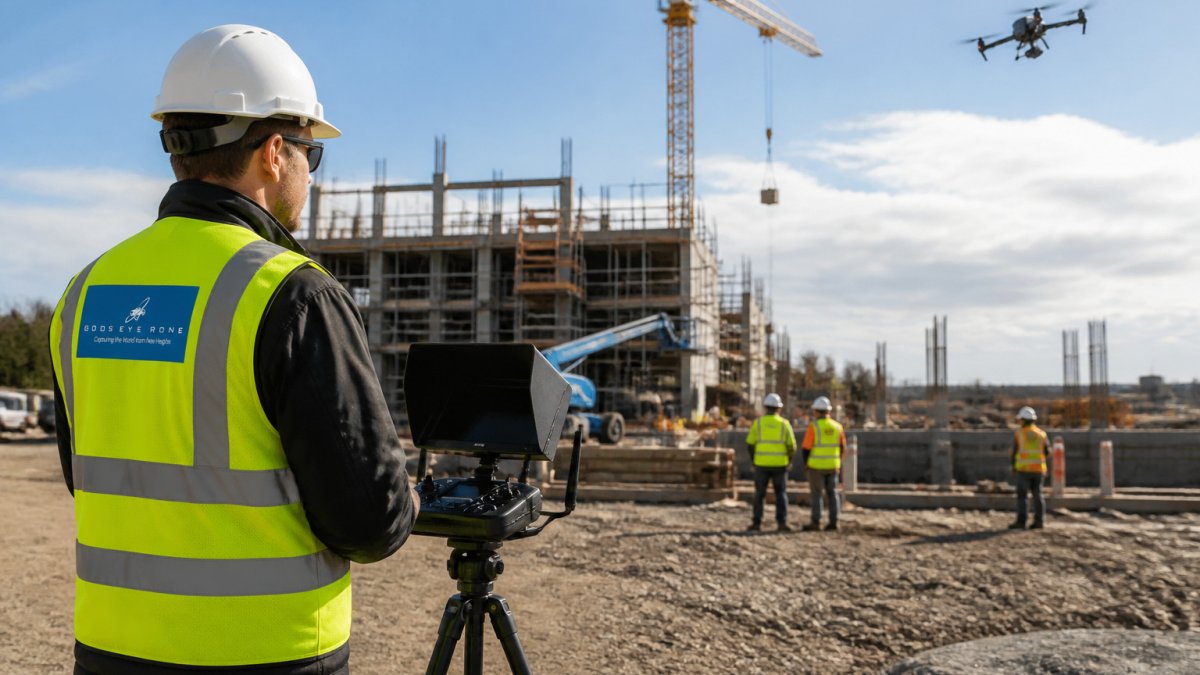
On a busy site, plan your flight path so that workers, equipment operators and passersby stay clear of the drone's route. Practical steps that most construction operators build into the mission:
- Define the overflight zone. Mark the area the drone will transit and confirm no workers are scheduled inside it during the flight window.
- Use a visual observer. A second set of eyes on the crew and the aircraft is the cheapest mitigation available and is often required for complex site geometry.
- Brief the crew before launch. Walk the foreman and the crew through the flight window, the route, and the abort signal. A 60-second briefing prevents most conflicts.
- Establish a safe perimeter. Keep non-essential personnel outside the flight area, and coordinate with the site safety officer so the drone plan is part of the project safety plan.
- Be ready to land immediately. If a worker walks into the flight path or conditions change, the pilot lands, no exceptions.
Documentation that protects the project
Operations-over-people compliance is easier to defend when it is documented. Keep the preflight briefing record, the flight log, and any waiver or means-of-compliance documentation with the project file.
Watch out: a valid certificate does not authorize flying directly over workers on an active site. Confirm your operation fits the rule's limits, or the terms of your waiver, before the flight begins.
Part 107 Night Operations and Anti-Collision Lighting
Night flying on construction sites requires extra preparation. Part 107 has specific requirements for night operations, including anti-collision lighting that makes the aircraft visible. Build these requirements into your pre-flight checklist and confirm the lights are working before every night mission.
Keep your flight log and pre-flight inspection records current, since they document that the aircraft and the pilot were ready for the mission.
Airspace Authorization, Waivers, and Flight Planning for Active Sites
Airspace is where construction flights most often get complicated, and it is the part of Part 107 that generic certification guides gloss over. Some operations that deviate from the specified rules need an FAA waiver, which the agency describes as permission to deviate from certain rules when the operator shows the operation can still be conducted safely FAA guidance on Part 107 waivers.
Check the airspace class before you mobilize
The complications start when a site falls inside Class B, C, D, or E surface-area airspace, common near urban cores, airports, and military installations. In those areas you need prior FAA authorization before launch.
A common pattern on construction jobs is to check the site's grid on a LAANC provider during pre-planning, confirm the ceiling altitude the grid allows, and file the authorization before the crew mobilizes, not the morning of the flight.
Plan around temporary restrictions
Active construction sites frequently sit near temporary flight restrictions (TFRs), wildfire response, VIP movement, stadium events, or security operations. A TFR can shut down a flight corridor with little notice. Build a TFR check into every preflight, not just the first flight of the project, because a restriction that did not exist on Monday can ground a Thursday inspection.
Waivers that matter on a jobsite
Some common construction missions require a waiver or a specific compliance path:
- Operations over people. Flying directly over workers, inspectors, or the public generally requires compliance with Part 107's operations-over-people rules (see the next section) or a waiver.
- Beyond visual line of sight (BVLOS). Long corridor inspections, linear infrastructure, and large-site mapping sometimes push past the pilot's visual range. BVLOS requires a waiver or an approved means of compliance.
- Night operations. Part 107 permits night flying with anti-collision lighting, but certain night missions near people or in controlled airspace may still need additional approval.
A waiver is not a rubber stamp. The FAA expects the applicant to describe the operation, the proposed mitigation, and the safety case.
Flight planning for an active site
Before flying near an active site, check airspace restrictions and plan your route. Jobsite flight planning should cover:
- Weather and wind. Cranes and tall formwork create turbulence and wind shear that differ from the forecast at ground level.
- Obstacles. Map crane jibs, boom swings, power lines, and scaffolding into the flight plan, and confirm crane positions with the operator before launch, crane jibs move during the day.
- Site communication. Brief the site supervisor and the crane operator on the flight window, the planned route, and the abort signal.
For more on mapping and surveying workflows, see our guide on Mapping and Surveying Drones: A 2026 Guide.
Construction-site drone work also carries safety obligations beyond holding a pilot certificate. The remote pilot in command remains responsible for the flight's safety and for documenting that the operation met the rules, including the airspace authorization under which it was flown.
Booking a Construction Drone Survey With Gods Eye Drone
If you would rather hand the flying to a professional, Gods Eye Drone offers aerial inspection services. You can book online or contact us to discuss your project, and you can review our construction drone inspection services before you decide.
Frequently Asked Questions
What are the FAA Part 107 requirements for construction drones?
To fly a drone commercially on a construction site under Part 107, the pilot must hold a Remote Pilot Certificate, the drone must be registered with the FAA, and the operation must follow the rules for altitude, visual line of sight, and airspace. Operations generally have altitude limits, so confirm the current ceiling in the FAA rule before flying. The remote pilot in command is responsible for making sure the aircraft poses no undue hazard to people, aircraft, or property. Operations that deviate from these rules need an FAA waiver.
Do construction drone pilots need a Part 107 certificate?
Yes. The FAA requires commercial operators flying under Part 107 to hold a Remote Pilot Certificate. Using a drone to survey, map, or inspect a construction site for a business generally counts as a commercial operation, even if the drone is small. Recreational flying rules under 14 CFR Part 107 do not cover this kind of work. Confirm your specific use case with the FAA before flying, especially if the work involves a third party or a paid contract.
Can a construction drone fly over workers under Part 107?
Part 107 restricts flights over people, and the limits depend on the drone and the level of risk. Check the operations-over-people rules before planning any flight over the work area. Flying over uninvolved people generally requires meeting specific conditions or an FAA waiver. Construction sites often have workers who are not part of the flight crew, so a site-specific risk assessment, a buffer zone, and communication with the site superintendent are standard practice. Check the operations-over-people rules in Part 107 before planning any flight path over the work area.
Can construction drones fly beyond visual line of sight?
Under standard Part 107 rules, the remote pilot must keep the drone in visual line of sight, meaning the pilot or a visual observer can see it unaided. Beyond visual line of sight (BVLOS) operations are not allowed under the standard rules and require a separate FAA waiver or approval. Many large construction sites are good candidates for BVLOS requests, but approval is not automatic and requires a detailed safety case.
What Part 107 rules apply to night flights at construction sites?
Part 107 permits night operations under specific conditions, including anti-collision lighting and pilot training requirements. Confirm the current rule text before flying at night. Pilots must also account for reduced visibility, so preflight checks, site lighting coordination, and a clear emergency plan are important. Night operations over an active site that involve people or moving equipment should be planned carefully and reviewed against the current rules before flight.
Do construction drones need to be registered with the FAA?
Yes. The FAA requires each drone intended for operation under Part 107 to be registered. Registration is separate from the pilot's Remote Pilot Certificate, and both are needed for compliant commercial construction work. Keep your registration current and make sure the registration matches the aircraft you actually fly on site.
When does a construction drone operation need an FAA waiver?
A waiver is needed when an operation deviates from a specific Part 107 rule, such as flying beyond visual line of sight, flying over people in certain categories, or exceeding standard altitude limits in some situations. The FAA describes waivers as permission to deviate from certain rules when the operator shows the operation can still be conducted safely. Waiver requests should describe the site, the risk mitigations, and the operating procedures in detail.
How can I prepare for the FAA Part 107 practice test?
Study the FAA's Part 107 knowledge test topics, including airspace, weather, loading and performance, and operations. Use the FAA's official study materials and a current practice test, and plan extra time for chart-reading questions. Check the current FAA exam outline before scheduling, since test content can change. Practice tests help you identify weak areas, but the official knowledge test is what determines certification.