 comparison
Drone vs Scaffolding for Inspections: A 2026 Comparison
Table of Contents
- Drone vs Scaffolding for Inspections: Key Differences
- Cost of Drone Building Inspection vs Traditional Scaffolding
- Drone Inspection vs Manual Inspection Time: Speed and Efficiency
- Safety Benefits and Risk Assessment
- OSHA Safety Requirements for Scaffolding and Drone Operations
- Data Accuracy, Image Resolution, and Inspection Frequency
- When to Choose Drones and When to Use Scaffolding
- Frequently Asked Questions
Last Updated: August 6, 2026
Drone vs Scaffolding for Inspections: Key Differences
When you need to inspect a tall building, bridge, or industrial structure, you face a fundamental choice: send workers up on scaffolding or deploy a drone. The difference shapes your project timeline, safety profile, and data quality. At Gods Eye Drone, the best method depends on what you're actually trying to accomplish.
Drones and scaffolding represent two fundamentally different approaches to vertical infrastructure inspection. Scaffolding requires physical access, human labor at height, and extensive setup time. Drones provide remote sensing capability, automated flight paths, and high-resolution imagery delivered in hours instead of weeks.
The core difference lies in how each method captures data. Scaffolding allows hands-on inspection and direct measurement. A worker can touch the surface, test material integrity, and make immediate assessments. Drones capture high-resolution imagery and thermal data without physical contact, creating a visual record for later analysis.
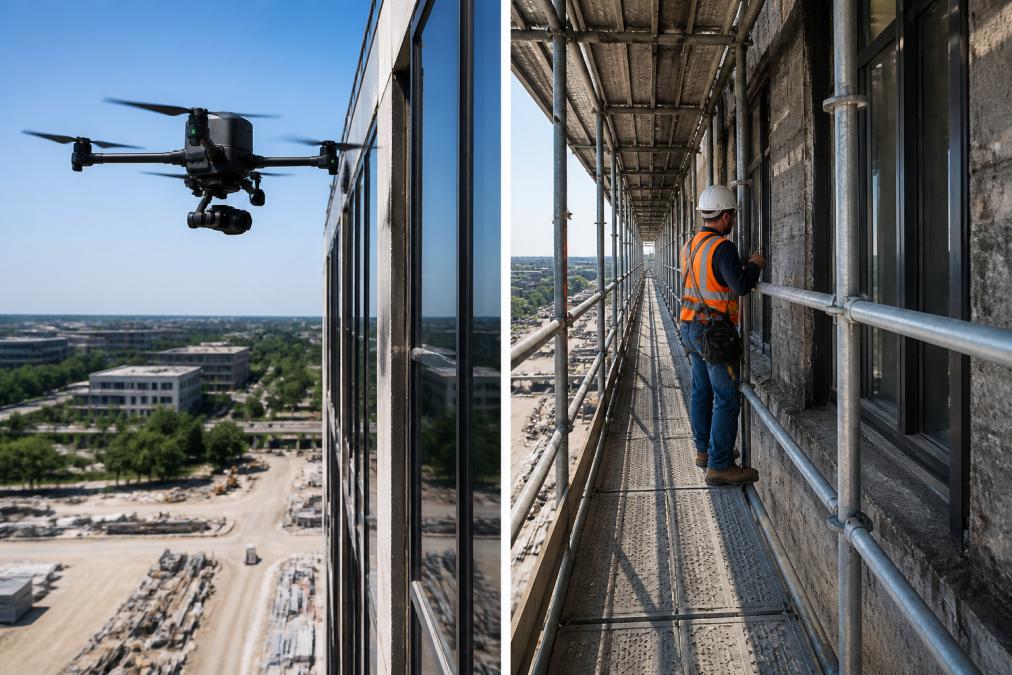
Operationally, scaffolding erection and dismantling can take weeks on complex projects. Drones are deployed and operational within hours. For preventative maintenance inspections requiring regular data-driven insights about asset condition, the speed advantage compounds quickly.
Cost structures differ dramatically. Scaffolding involves rental, erection labor, safety equipment, and worker wages at height. Drones require equipment investment upfront and certified pilot labor, but per-inspection cost drops as you scale. A single inspection might favor scaffolding on price; five inspections per year shifts the equation entirely.
Cost of Drone Building Inspection vs Traditional Scaffolding
Direct cost comparison between drone inspections and scaffolding reveals significant differences in total project cost, not just per-inspection pricing.
Scaffolding costs include rental fees, erection and dismantling labor, safety certifications, worker wages, and insurance premiums. For a mid-rise building inspection, these costs easily reach five figures. Timeline delays also matter: if your inspection delays a project by three weeks, indirect costs (lost productivity, delayed occupancy, extended financing) often dwarf the inspection cost itself.
Drone inspection pricing depends on scope, location, and data complexity. A straightforward visual flight costs less than thermographic inspection with orthomosaic mapping. Most drone inspections complete in one to three days, versus weeks for equivalent scaffolding projects.
The cost advantage of drones emerges at scale. Your first drone inspection might cost more per hour than scaffolding labor. Your fifth inspection this year? Drones become dramatically more cost-effective because you're not re-renting and re-erecting scaffolding. For asset owners conducting quarterly or annual inspections, drones typically show 40-60% lower total cost over a 12-month period.
Operational downtime also matters. Scaffolding blocks building facades and disrupts normal operations. Drones operate without interrupting tenant activities or site workflows. For occupied buildings, this translates directly to cost savings.
Insurance and liability costs also diverge. Scaffolding requires extensive safety protocols and worker compensation coverage. Drones require pilot certification and equipment liability insurance, typically lower premiums for certified operators like Gods Eye Drone. The risk profile is fundamentally lower.
One critical caveat: if your inspection requires hands-on testing, material sampling, or direct measurement, scaffolding becomes necessary. For purely visual assessment and data-driven insights about structural condition, drones win on cost.
Drone Inspection vs Manual Inspection Time: Speed and Efficiency
The timeline difference between drone and manual inspection is the most dramatic operational advantage drones deliver, directly impacting project schedules and maintenance frequency.
A traditional scaffolding inspection for a four-story building typically requires:
- Permit and safety planning: 3-5 days
- Scaffolding erection: 5-10 days
- Inspection and documentation: 3-7 days
- Dismantling: 3-5 days
- Data analysis and reporting: 2-5 days
Total timeline: 16-32 days, often stretching to 6 weeks with delays.
A drone inspection for the same building requires:
- Flight planning and weather assessment: 1 day
- On-site flight and data capture: 1-2 days
- Data processing and analysis: 1-3 days
Total timeline: 3-6 days, often completed within a single week.
This speed advantage enables prevention-focused maintenance cycles. Organizations conducting quarterly inspections find that drone operations enable frequent data-driven insights. With scaffolding, quarterly inspections are cost-prohibitive; most asset owners default to annual or biennial inspections, missing early warning signs.
Speed also reduces project delays. If a structural concern emerges mid-construction, drone inspection can provide answers within days. Scaffolding-based inspection might delay the project by three weeks, pushing completion dates and increasing financing costs.
Weather and site access also affect timeline differently. Drones operate in broader weather windows than scaffolding. Difficult-to-access areas requiring extensive scaffolding setup can be surveyed by drone in hours.
Data delivery timeline also matters. Scaffolding inspection produces field notes requiring manual compilation. Drone flights generate high-resolution imagery and thermal data processed into comprehensive reports within days.
Safety Benefits and Risk Assessment
The safety profile of drone inspection versus scaffolding represents one of the most compelling reasons to choose UAV technology for vertical infrastructure assessment.
Scaffolding inspection exposes workers to hazards inherent in working at height. Falls remain the leading cause of construction fatalities. Even with proper safety equipment, workers at height face real risk from weather exposure, fatigue, and psychological stress.
Drones eliminate worker exposure to height hazards entirely. The pilot operates from ground level, controlling the aircraft remotely. There is no fall risk, no exposure to weather at elevation, and no physical exertion in dangerous positions.
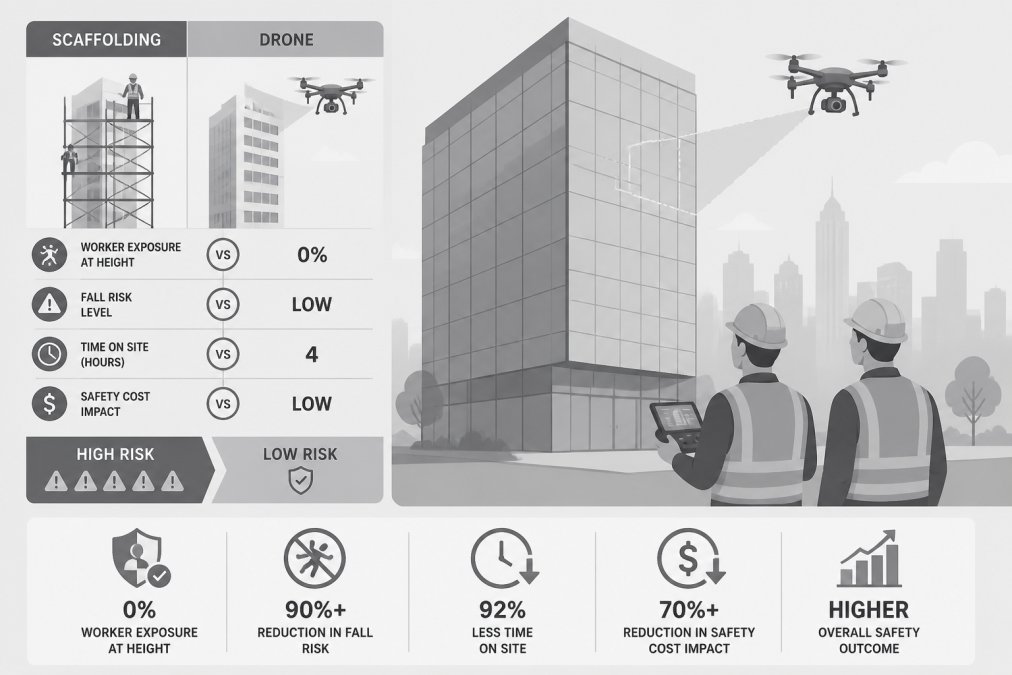
Risk assessment for drone operations is more predictable. Certified pilots follow standardized protocols, maintain equipment to rigorous standards, and operate within defined parameters. Drone operations have a documented safety record; the risk profile is well-understood and manageable.
For your organization, the liability implications are significant. Workers' compensation claims for scaffolding-related injuries are costly and create ongoing exposure. Drone operations with certified professionals shift liability to equipment and pilot error, a fundamentally lower-risk profile. Insurance premiums reflect this difference; drone inspection typically carries lower liability costs.
OSHA Safety Requirements for Scaffolding and Drone Operations
Federal safety regulations govern both inspection methods, but the regulatory frameworks differ significantly.
Scaffolding falls under OSHA 29 CFR 1926 Subpart L, the Scaffolding Standard. Key requirements include competent person certification, regular pre-shift and periodic inspections documented in writing, load capacity calculations, fall protection systems, and training documentation. Compliance requires substantial infrastructure and carries penalties up to thousands of dollars per violation.
Drone operations fall under FAA Part 107 regulations for commercial flights. Requirements include Remote Pilot Certificate (Part 107 license), aircraft registration and airworthiness documentation, flight planning within approved airspace, daylight-only operations, visual line-of-sight maintenance, and weather compliance. Gods Eye Drone maintains full Part 107 compliance with certified pilots.
The practical difference: OSHA scaffolding compliance is ongoing and labor-intensive. Every inspection requires documented pre-shift checks and periodic inspections. FAA Part 107 compliance is primarily front-loaded: the pilot must be certified, the aircraft registered, and the flight planned within regulatory parameters.
For asset owners conducting frequent inspections, quarterly drone inspections require consistent Part 107 compliance but no per-inspection scaffolding protocol overhead.
Data Accuracy, Image Resolution, and Inspection Frequency
The quality and type of data you collect fundamentally shapes what you learn about your asset's condition.
Drone inspection produces high-resolution imagery and specialized sensor data. Modern drones capture 4K video, still photography at 20+ megapixels, and thermal imaging revealing temperature variations invisible to the human eye. This data can be processed into orthomosaic mapping, georeferenced imagery allowing precise measurement and comparison over time. Point cloud data from LiDAR sensors creates three-dimensional models enabling detailed analysis of geometry and structural changes.
Drone-captured data is high and consistent. Automated flight paths ensure consistent image overlap and resolution. Thermal imaging reveals moisture intrusion, insulation failures, and thermal bridging that visual inspection alone cannot detect. For preventative maintenance, this data-driven approach identifies problems before they become visible.
Scaffolding inspection produces direct visual assessment and field notes. A trained inspector can identify visible damage and assess material condition. However, this assessment is subjective and difficult to compare over time. Thermal issues and early-stage deterioration may be missed without specialized equipment.
Inspection frequency also affects data value. Scaffolding cost and timeline constraints typically limit inspections to annual or biennial cycles. Drones enable quarterly or monthly inspection cycles, creating a continuous data stream revealing trends and early warning signs.
Gods Eye Drone's state-of-the-art FLIR equipment captures thermal data at high resolution, enabling detection of problems that standard visual inspection misses, transforming inspection data into actionable intelligence about asset condition.
When to Choose Drones and When to Use Scaffolding
The decision between drones and scaffolding should be based on your specific inspection objectives.
Choose drones when:
- Your primary objective is visual documentation and condition assessment of exterior facades, roofs, or vertical infrastructure
- You need frequent inspections to track condition trends and enable preventative maintenance
- The structure is tall, difficult to access, or poses significant worker safety hazards
- You need thermal imaging to detect moisture intrusion or insulation failures
- Your timeline is constrained and you need rapid turnaround on inspection data
- You're conducting site progress monitoring or construction documentation
- Your budget prioritizes lower overall cost across multiple inspections annually
Choose scaffolding when:
- Your inspection requires hands-on testing, material sampling, or direct measurement
- You need to perform repairs or maintenance work while accessing the structure
- The inspection requires extended time at height for detailed tactile assessment
- Your structure is low-rise or easily accessible
- You're conducting a one-time inspection where timeline doesn't create cost advantages for drones
- Your inspection requires work that drones cannot perform
The hybrid approach is also valid. Many complex inspections benefit from both methods: drones provide initial visual assessment and thermal data, identifying areas of concern. Scaffolding then provides targeted access for hands-on evaluation of specific problems.
For Gods Eye Drone clients, the decision framework is straightforward: if your inspection objective can be achieved through visual documentation, thermal imaging, and data-driven analysis, drones deliver superior speed, safety, and cost-effectiveness. If your inspection requires hands-on assessment or repair work, scaffolding becomes necessary.
The choice between drone and scaffolding inspection isn't about technology preference, it's about matching your inspection method to your actual objective. Drones excel at frequent, rapid-turnaround visual and thermal assessment. Scaffolding provides the hands-on access that some inspections require. For most asset owners conducting regular condition assessment and preventative maintenance, drones deliver faster results, better safety outcomes, and lower total cost. Gods Eye Drone brings certified expertise, state-of-the-art thermal imaging equipment, and proven operational excellence to every inspection project. Whether you're managing building envelope assessment, infrastructure monitoring, or emergency response situations, our team delivers the aerial intelligence you need to make informed decisions about your assets. Book a consultation with Gods Eye Drone today and discover how professional drone inspection can transform your maintenance strategy and reduce operational risk.
| Inspection Method | Setup Time | Cost Per Inspection | Safety Profile | Data Type | Best For |
|---|---|---|---|---|---|
| Drone | 1-2 days | Lower at scale | Eliminates height hazards | Visual, thermal, orthomosaic | Frequent monitoring, visual assessment |
| Scaffolding | 2-4 weeks | Higher per inspection | Worker exposure to height | Visual, tactile, direct measurement | Hands-on testing, repairs |
| Hybrid Approach | 2-3 weeks | Moderate | Mixed | Comprehensive | Complex multi-phase inspections |
Frequently Asked Questions
Are drone inspections cheaper than scaffolding?
Drones generally reduce overall project costs compared to traditional scaffolding. Scaffolding requires erection, labor for climbers, and dismantling, all significant expenses for high-rise or complex structures. Drones eliminate these labor-intensive steps and operational downtime. However, pricing depends on project scope, location, and specific inspection requirements. Contact Gods Eye Drone for a detailed quote tailored to your building inspection needs.
What are the safety benefits of using drones for building inspections?
UAV technology removes workers from height-related hazards, the leading cause of construction injuries. Traditional rope access and cherry picker methods expose inspectors to falls, equipment failure, and weather-related risks. Drones eliminate these dangers while providing high-resolution imagery and thermal imaging for thorough structural integrity assessments. This reduces liability exposure and insurance costs while keeping your team safe.
How much faster are drone inspections compared to manual methods?
Drone inspection vs manual inspection time shows dramatic differences. A drone can survey a multi-story building facade in hours, while rope access or scaffolding setup takes days or weeks. Drones reduce labor hours significantly, minimize operational downtime, and accelerate project timelines. For building envelope assessments or preventative maintenance documentation, drones deliver data-driven insights in a fraction of the time traditional methods require.
What certifications and insurance does Gods Eye Drone carry for inspections?
Gods Eye Drone operates with certified drone pilots trained in commercial operations. Our team maintains current FAA Part 107 certification and carries comprehensive liability insurance for inspection work. For critical infrastructure or high-value asset assessments, we provide detailed documentation of our compliance standards and insurance coverage. Contact us directly to discuss your specific insurance and certification requirements before booking.
This article was written using GrandRanker