 how-to
How Drone Inspections Reduce Infrastructure Costs
Table of Contents
- How Drone Inspections Reduce Infrastructure Costs: The Economics Behind Aerial Assessment
- Why Traditional Inspection Methods Drain Budgets
- Eliminating Labor and Access Costs: Scaffolding, Rope Access, and Bucket Trucks
- Safety Benefits and Risk Mitigation That Lower Liability Costs
- Cost Comparison: Manual vs Drone Inspection Methods
- Real-World Applications: Bridge Decks, Transmission Lines, and Pipeline Integrity
- FAA Part 107 Infrastructure Inspection Requirements and Compliance Costs
- Drone Inspection Software Tools and Data Integration Overhead
- Reducing Downtime and Revenue Loss Through Predictive Maintenance
- Frequently Asked Questions
Last Updated: August 4, 2026
How Drone Inspections Reduce Infrastructure Costs: The Economics Behind Aerial Assessment
Traditional inspection methods are expensive, dangerous, and inefficient. Gods Eye Drone has helped infrastructure managers across the United States recognize that aerial assessment represents a fundamental shift in how assets get monitored and maintained. Rather than deploying crews to scaffolding, rope access systems, or bucket trucks for hours or days, organizations now deploy UAV technology to capture comprehensive data in minutes.
The economics are compelling. Eliminating expensive access equipment rental, reducing labor hours on high-risk work, and increasing inspection frequency without proportional cost increases creates rapid savings. Most infrastructure assets benefit from more frequent monitoring than traditional budgets allow. Drone inspections make that frequency economically viable.
Below, we'll show you exactly where costs drop when you switch from manual inspection methods to aerial platforms, and how to calculate when drone inspections pay for themselves on your specific assets.
Why Traditional Inspection Methods Drain Budgets
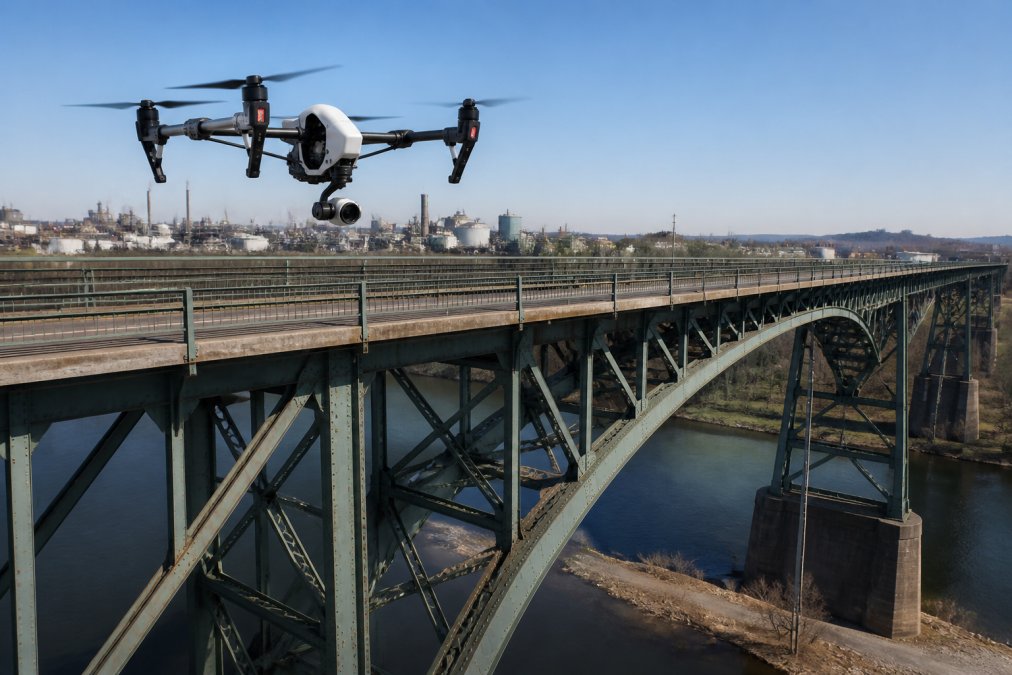
A single bridge deck inspection using traditional access methods typically requires equipment rental ($1,000-$3,000 per day), specialized crews working at height (4-8 workers for 2-5 days), traffic control and permits, safety protocols and insurance premiums, mobilization time, and asset downtime. Total cost ranges from $15,000 to $50,000 depending on span length and complexity. Pipeline inspections requiring rope access crews can exceed $100,000 for a single site.
Beyond direct costs, traditional methods create hidden expenses. Worker injuries drive up insurance premiums. Limited inspection frequency due to high per-inspection costs means problems go undetected longer, compounding maintenance costs downstream. Asset downtime during inspection windows represents lost revenue or operational disruption that doesn't appear in the inspection budget but absolutely affects the bottom line.
Eliminating Labor and Access Costs: Scaffolding, Rope Access, and Bucket Trucks
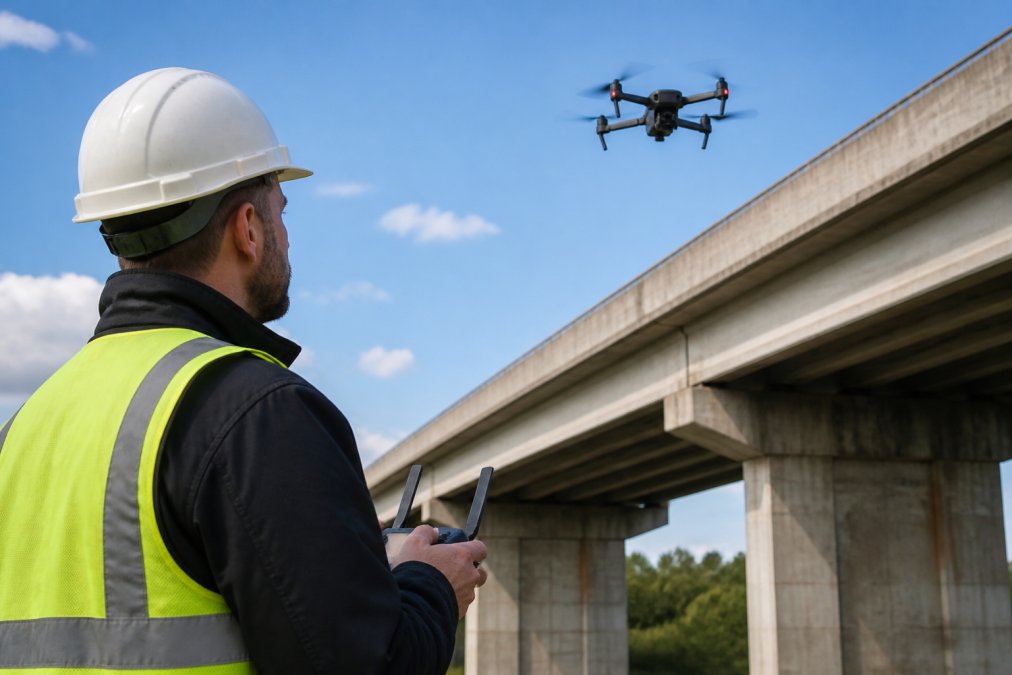
Drone inspections eliminate the need for expensive access equipment entirely. A certified UAV pilot can capture high-resolution imagery, thermal data, and structural measurements from the ground, reducing labor requirements dramatically.
For a bridge deck inspection, traditional methods require a crew of 4-6 workers spending 3-5 days on site. Drone inspection requires one or two certified pilots spending 2-4 hours total, an 85-95% labor cost reduction per inspection event.
For transmission line inspections spanning multiple miles, a traditional rope access crew might spend 10-15 days inspecting a single corridor. A drone team covers the same distance in 1-2 days. The per-mile inspection cost drops from $500-$1,200 to $150-$400.
Pipeline inspections present similar advantages. External drone inspection captures surface condition, corrosion patterns, and environmental hazards without shutdown, specialized training overhead, or confined-space liability exposure.
Safety Benefits and Risk Mitigation That Lower Liability Costs
Removing workers from high-risk environments directly reduces accident frequency and severity. Working at height on bridges, towers, and transmission lines consistently ranks among the most dangerous occupations. According to OSHA statistics on fall-related injuries, falls remain the leading cause of death in construction and infrastructure maintenance.
Drone inspections eliminate that risk entirely. The pilot operates from the ground with full situational awareness and control. This risk elimination translates directly to lower workers' compensation insurance premiums and reduced liability exposure.
Insurance carriers recognize the safety advantage and often offer premium reductions of 5-15% for organizations that transition high-risk inspection work to drone platforms. For organizations managing multiple high-risk assets, this insurance savings alone can justify drone inspection adoption within 12-24 months. A single serious injury on a bridge inspection can cost $500,000-$2,000,000 in medical care, workers' comp, legal fees, and operational disruption. Avoiding that single incident pays for years of drone inspections.
Cost Comparison: Manual vs Drone Inspection Methods
To understand how drone inspections reduce infrastructure costs in concrete terms, consider these typical scenarios:
Bridge Deck Inspection (500-foot span):
| Inspection Method | Equipment Cost | Labor Cost | Duration | Total Cost |
|---|---|---|---|---|
| Bucket truck + crew | $2,500 | $8,000 | 4 days | $10,500 |
| Rope access team | $3,200 | $12,000 | 3 days | $15,200 |
| Drone inspection | $400 | $2,000 | 4 hours | $2,400 |
Transmission Line Corridor (10 miles):
| Inspection Method | Equipment Cost | Labor Cost | Duration | Total Cost |
|---|---|---|---|---|
| Ground crew + truck | $1,800 | $6,000 | 8 days | $7,800 |
| Helicopter survey | $8,000 | $3,000 | 1 day | $11,000 |
| Drone inspection | $600 | $1,200 | 2 days | $1,800 |
The cost advantage becomes more pronounced when you factor in inspection frequency. Traditional methods constrain frequency due to cost. Drone inspections cost so little that monthly or quarterly monitoring becomes economically viable. When you increase inspection frequency from annual to quarterly, you catch deterioration earlier, shifting maintenance from emergency response (expensive, disruptive) to planned preventative work (cheaper, scheduled during off-peak periods). This frequency advantage typically saves 30-50% on total maintenance costs over a 5-year period.
Real-World Applications: Bridge Decks, Transmission Lines, and Pipeline Integrity
Drone inspections deliver measurable cost reductions across every infrastructure asset class.
Bridge and Road Infrastructure Monitoring
Bridge decks deteriorate through freeze-thaw cycles, salt exposure, traffic stress, and water infiltration. Quarterly drone inspections with high-resolution imagery and thermal analysis identify problem areas when repair costs are minimal. A typical state DOT manages 5,000-10,000 bridge assets. Drone inspections make comprehensive coverage feasible. When a bridge engineer can review high-resolution thermal imagery showing moisture infiltration patterns, they can schedule targeted waterproofing work before the problem cascades into structural repair. That single intervention often saves $50,000-$200,000 in emergency structural work.
Transmission Line and Pipeline Inspection Frequency
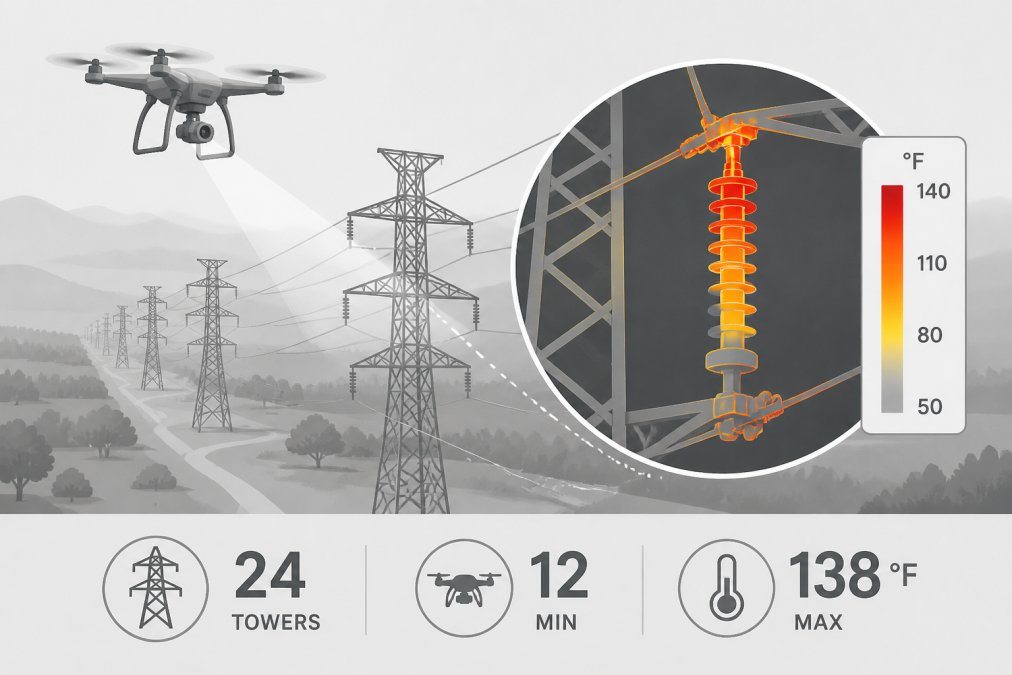
Transmission lines and pipelines span hundreds or thousands of miles. Drone inspection covers entire corridors at reasonable cost, creating a complete asset inventory. For transmission lines, drone inspections identify insulator contamination, hardware corrosion, vegetation encroachment, and structural stress. For pipelines, external drone surveys capture coating condition, corrosion hotspots, and environmental threats.
Pipeline operators report that comprehensive drone surveys reduce unplanned outages by 40-60% compared to organizations relying on traditional inspection methods. Unplanned outages cost $100,000-$500,000 per event in lost revenue, emergency response, and repair work. Preventing even two unplanned outages per year via improved inspection frequency pays for a comprehensive drone inspection program indefinitely.
FAA Part 107 Infrastructure Inspection Requirements and Compliance Costs
Operating drones for commercial infrastructure inspection requires FAA Part 107 certification. Part 107 mandates that commercial drone pilots hold a Remote Pilot Certificate, maintain currency through recurrent training, and operate within specific parameters: daylight operations, visual line of sight, maximum altitude of 400 feet, and compliance with airspace restrictions near airports.
Certification costs are minimal, the initial exam fee runs approximately $175, and recurrent training typically costs $500-$1,000 annually. Infrastructure sites often require airspace coordination with local authorities, especially near airports or controlled airspace. Some inspections require special waivers for operations beyond visual line of sight or at altitudes exceeding 400 feet.
Commercial drone operators carrying liability coverage typically pay $500-$2,000 annually depending on coverage limits and asset value. Organizations managing critical infrastructure often require $1 million-$5 million in liability coverage.
Gods Eye Drone maintains full Part 107 compliance and carries comprehensive liability coverage appropriate for infrastructure work. Our certified pilots handle airspace coordination and regulatory requirements, eliminating that overhead from your internal team.
Drone Inspection Software Tools and Data Integration Overhead
High-resolution imagery, thermal data, and LiDAR point clouds generate massive datasets. Processing that raw data into actionable intelligence requires software tools and skilled analysis.
A single bridge inspection produces 500-2,000 individual images. A 10-mile transmission line survey generates 5,000-15,000 images plus thermal and LiDAR datasets. Organizations need software to stitch imagery into orthomosaics, process thermal data into temperature maps, generate 3D models from point clouds, and create comparison analysis showing changes between inspection cycles.
Cloud-based analytics platforms enable automated defect detection, change analysis, and digital twin development. These platforms typically cost $500-$5,000 monthly depending on data volume and analysis sophistication. However, the software cost rarely exceeds the labor savings from eliminating traditional inspection methods. A $2,000 monthly software subscription is offset by eliminating a single traditional inspection ($10,000-$20,000 cost). For organizations conducting quarterly inspections, software costs represent 10-15% of total inspection program cost.
Reducing Downtime and Revenue Loss Through Predictive Maintenance
The most underestimated cost of traditional inspections is asset downtime. When you inspect a bridge, you often need lane closures. When you inspect a pipeline, you may need to shut down operations. When you inspect a cellular tower, you may need to power down service. These operational interruptions carry direct revenue impact.
Drone inspections eliminate downtime entirely. A bridge inspection via drone requires no lane closures. A pipeline inspection via drone requires no shutdown. A tower inspection via drone requires no service interruption.
Consider a major bridge carrying 50,000 vehicles daily. A traditional inspection requiring one lane closure costs approximately $100,000 in lost toll revenue and increased congestion costs. A drone inspection eliminates that cost entirely. For an organization managing 20 major bridges, switching to drone inspection saves $2 million annually in avoided downtime costs.
Increased inspection frequency without downtime enables predictive maintenance. Instead of waiting for annual inspections to identify problems, you monitor assets continuously through quarterly or monthly drone surveys. Early detection of deterioration allows you to schedule maintenance during planned downtime windows rather than responding to emergencies. This shift from reactive to predictive maintenance typically reduces total maintenance costs by 25-40% over a 5-year period.
Frequently Asked Questions
How much can drone inspections actually save compared to traditional methods?
Savings depend on asset type, inspection frequency, and access difficulty. Traditional methods like scaffolding and rope access require significant labor, equipment rental, and crew mobilization costs. Drone inspections eliminate or reduce these expenses while enabling more frequent assessments. For bridge and transmission line work, savings typically range from 40-70% per inspection cycle when accounting for labor reduction, equipment rental elimination, and faster deployment. Long-term ROI improves further through predictive maintenance and early defect detection.
What FAA Part 107 infrastructure inspection requirements apply to my project?
FAA Part 107 requires that commercial drone operators hold a Remote Pilot Certificate, maintain visual line of sight, operate during daylight, and follow airspace restrictions. For infrastructure inspections, you must verify local airspace clearance and coordinate with relevant authorities. Hiring certified pilots ensures compliance and proper insurance coverage. Compliance overhead is minimal when working with experienced operators, but it is a required cost factor. Verify your drone service provider holds current Part 107 certification and appropriate liability insurance before contracting.
How do drone inspection software tools integrate with our existing asset management systems?
Modern drone inspection software captures high-resolution imagery, thermal data, and LiDAR point clouds, then processes this into actionable reports and digital twins. Integration depends on your current software platform and data structure. Cloud-based analytics tools can ingest raw imagery and automate defect detection, anomaly flagging, and trend analysis. Some software supports API connections to CMMS and EAM systems. Data integration overhead exists but is manageable with proper planning. Discuss software compatibility and data export formats with your drone service provider during the planning phase to avoid costly rework.
Can drone inspections detect structural defects as reliably as manual inspections?
Yes, when properly equipped and executed. High-resolution imagery (0.5-1 cm per pixel), thermal imaging, and LiDAR capture details comparable to or exceeding what human inspectors detect on-site. Drones eliminate the fatigue and access limitations that reduce inspector accuracy on dangerous assets. The real advantage is inspection frequency: you can assess assets monthly or quarterly instead of annually, catching defects earlier when repair costs are lower. Combined with automated software analysis, drone-acquired data often detects problems before human inspectors would notice them.
This article was written using GrandRanker