 how-to
Hiring Certified Drone Pilots for Industrial Inspections
Table of Contents
- What Industrial Inspection Work Actually Requires From a Drone Pilot
- FAA Part 107 Certification Requirements You Should Verify Before Hiring
- Drone Inspection Equipment Checklist: What a Capable Fleet Looks Like
- Insurance, Liability, and Site-Specific Safety Protocols
- The Cost of Hiring Professional Drone Inspection Teams (And What Drives It)
- Data Deliverables: What You Should Receive After the Flight
- How to Vet Certified Drone Pilots for Industrial Inspections: A Step-by-Step Process
- Conclusion: The Right Pilot Protects the Asset and the Schedule
- Frequently Asked Questions
Last Updated: September 18, 2026
What Industrial Inspection Work Actually Requires From a Drone Pilot
Hiring certified drone pilots for industrial inspections means verifying a specific skill set, not just a license. A capable pilot combines FAA certification, inspection-specific sensor training, and the judgment to fly safely around live infrastructure. The gap between a hobbyist and a qualified industrial inspector is wide.
The Six Types of Industrial Drone Inspections
Most industrial work falls into six categories, each changing the equipment, flight profile, and deliverable.
- Cell tower inspection - close passes around antennas, mounts, and guy wires
- Power line inspection - linear flight paths along transmission corridors
- Roof and building envelope inspection - grid patterns capturing every plane
- Thermal and leak detection - FLIR payloads scanning for hot spots or moisture
- Construction progress monitoring - repeatable flight paths at set intervals
- Agricultural and environmental survey - multispectral imaging for crop and irrigation analysis
FAA Part 107 Certification Requirements You Should Verify Before Hiring
The baseline credential is a remote pilot certificate issued under Part 107 certification requirements from the FAA, the legal minimum to fly a UAV commercially. Verify it before you sign anything.
Drone Inspection Equipment Checklist: What a Capable Fleet Looks Like
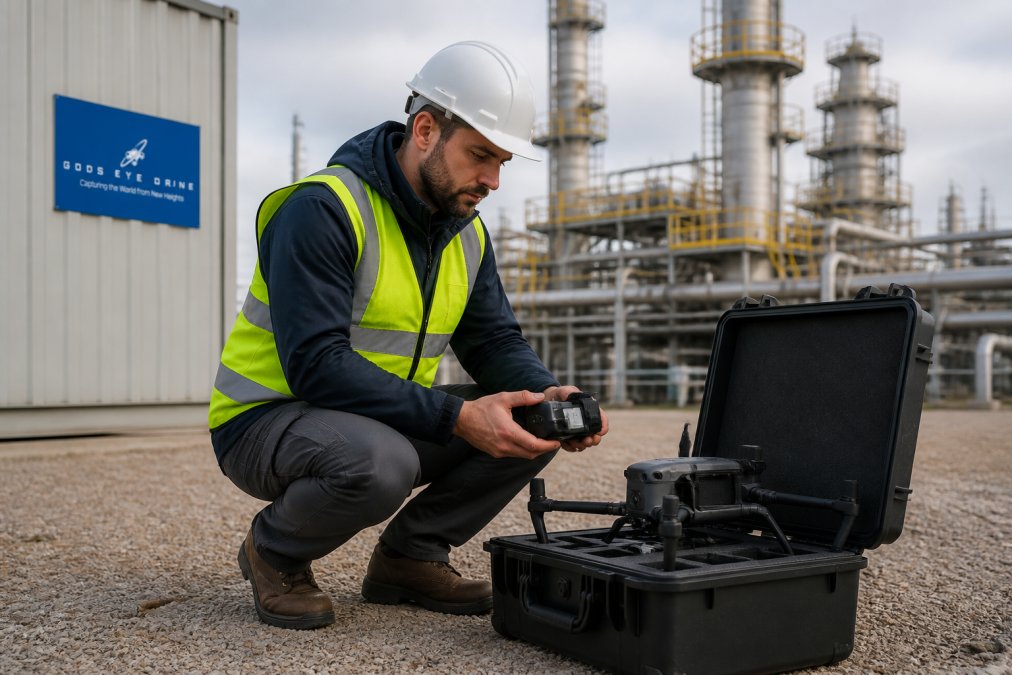
A professional drone inspection fleet includes specific hardware, and missing any of it usually means the pilot is improvising. The real question is whether the pilot can match the right payload to the right inspection and explain the trade-offs.
The Core Airframe and Payload Stack
The drone inspection equipment checklist for industrial work typically covers:
- UAV airframe rated for the environment. Industrial sites mean wind, temperature extremes, and electromagnetic interference near power lines. A consumer quadcopter is not the same tool as a commercial airframe with higher wind tolerance and redundant flight systems.
- Thermal imaging payload (FLIR or equivalent) for heat and moisture detection. Resolution drives whether you can spot a loose connection on a substation or only a broad temperature difference across a roof.
- High-resolution RGB camera for visual documentation and photogrammetry. Photogrammetry needs a mechanical shutter and consistent overlap; a rolling-shutter consumer camera produces distorted models.
- LiDAR or multispectral sensor for point cloud or crop analysis. LiDAR penetrates vegetation and works in low light; photogrammetry does not. The pilot should explain when each is right.
- Sensor integration hardware that lets payloads swap without recalibration. A pilot who must send the aircraft to a dealer to change sensors is not set up for multi-payload work.
- Ground control station with flight planning software. This is where repeatable flight paths are built, essential for construction progress monitoring and change detection.
- Spare batteries and props sized for the longest single flight. Industrial sites are often remote; running out of battery mid-mission wastes your inspection window.
- Safety kit including cones, high-visibility vests, and radio communication gear.
Payload Trade-Offs the Pilot Should Be Able to Explain
A capable pilot can explain why one payload beats another for your asset. Three trade-offs come up constantly:
- Thermal vs. RGB for roof inspections. Thermal finds moisture intrusion and insulation gaps RGB cannot see; RGB documents the visible surface. A serious roof inspection uses both and aligns them.
- LiDAR vs. photogrammetry for point clouds. LiDAR produces accurate point clouds in low light and through light vegetation, but hardware is expensive and files are large. Photogrammetry is cheaper and colorized, but fails in low light and struggles with reflective or uniform surfaces.
- Multispectral vs. RGB for agricultural and environmental survey. Multispectral captures non-visible bands used for vegetation indices; RGB cannot. If the deliverable is a crop health map, multispectral is not optional.
What the Equipment List Tells You About the Deliverables
The equipment a pilot owns previews the data you will receive. A pilot with a thermal payload and photogrammetry software can hand over thermal overlays and orthomosaics; one with only an RGB camera and no processing software hands over JPEGs.
Insurance, Liability, and Site-Specific Safety Protocols
Insurance and site safety are the two items most hiring managers forget to check, and both come back to bite you if something goes wrong. Most hiring guides stop at "ask for a certificate of insurance" and never explain what coverage actually looks like on an industrial site.
What Coverage a Certified Drone Pilot Should Carry
Request a certificate of insurance (COI) before the flight. A professional industrial operator typically carries two policies:
- Aviation liability coverage, sometimes called unmanned aircraft liability. This responds to a hull loss or third-party injury caused by the aircraft. Look for at least $1,000,000 per occurrence; many industrial site owners require $5,000,000 near energized or high-value assets.
- General liability (CGL), the same policy any contractor carries, covering non-aviation exposures like a pilot tripping a site worker or damaging a parked vehicle with ground equipment.
Two details matter more than the limits:
- Additional insured endorsement. Ask that your company be named as an additional insured on the pilot's aviation policy for the job's duration. This gives you direct rights under their policy if a claim arises; a COI alone does not.
- Waiver of subrogation. Confirm the policy waives the insurer's right to pursue your company after paying a claim. Without it, the pilot's insurer can come after you.
Site-Specific Safety Protocols and OSHA Compliance
Industrial sites are workplaces, and drone pilots working on them are subject to the same safety regime as any other contractor. The relevant framework is OSHA's general industry and construction standards, depending on the site.
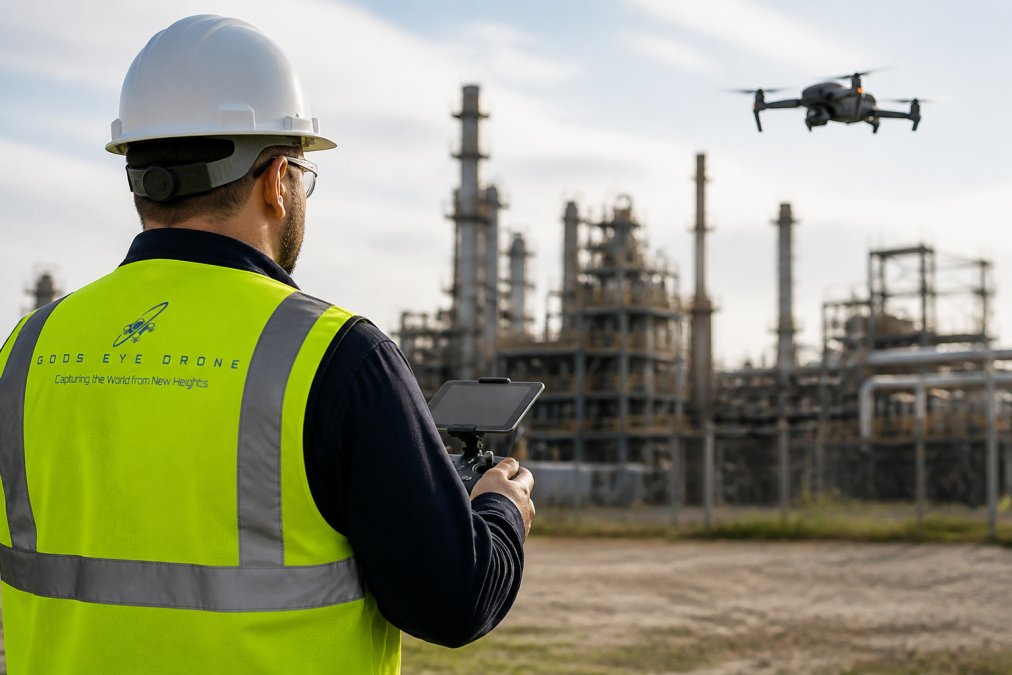
- Personal protective equipment (PPE). Hard hat, ANSI-rated high-visibility vest, safety glasses, and steel-toe boots are baseline on most industrial sites. Some facilities require FR (flame-resistant) clothing near electrical or petrochemical assets. The pilot should ask what the site requires before arrival, not after.
- Lockout/tagout (LOTO). If the inspection requires flying near equipment that could energize or move, the pilot must coordinate with your maintenance team on LOTO procedures. A drone pilot does not perform LOTO, but they must not fly into a zone where equipment could restart.
- Energized electrical work boundaries. Approach distances to energized conductors are governed by OSHA and by the site's own electrical safety program. A pilot flying a transmission corridor needs to know the minimum approach distance for the voltage class involved.
- Site-specific orientation. Many facilities require a short safety orientation, a visitor badge, and an escort. Build this into the schedule, it is not optional and it is not the pilot's problem to solve on arrival.
Pre-Flight Planning and Abort Criteria
Risk mitigation on industrial sites comes down to three things: pre-flight planning, redundant equipment, and clear abort criteria.
A Note on Waivers and Airspace
Site safety and airspace authorization overlap. If the job requires flying in controlled airspace, the pilot needs FAA authorization through the Low Altitude Authorization and Notification Capability (LAANC) or a manual waiver. If it requires beyond visual line of sight (BVLOS) operations, a separate waiver is required. Ask to see the documentation for any job that needs it, a verbal assurance is not enough.
The Cost of Hiring Professional Drone Inspection Teams (And What Drives It)
The cost of hiring professional drone inspection teams depends on scope, not a flat rate. Pricing reflects flight time, sensor requirements, travel, data processing hours, and reporting depth. A single roof inspection and a multi-day power line corridor scan are not the same job.
What drives the price up:
- Specialized payloads like thermal, LiDAR, or multispectral sensors
- Large or linear sites that require multiple flights and battery swaps
- Complex airspace requiring FAA authorization or coordination
- Detailed deliverables like point clouds, orthomosaics, or GIS mapping layers
- Tight timelines that push crews into overtime or weekend work
Data Deliverables: What You Should Receive After the Flight
Raw footage is not a deliverable. It is a starting point that most clients never use.
- Orthomosaic - a stitched, georeferenced top-down image of the site
- Point cloud - a 3D model useful for measurement and change detection
- Thermal overlays - heat maps aligned with RGB imagery
- GIS mapping layers - files that drop into your existing asset management system
- Technical reporting - annotated findings with location references
- Flight logs - timestamped records for compliance and audit trails
How to Vet Certified Drone Pilots for Industrial Inspections: A Step-by-Step Process
Vetting takes about an hour if you know what to ask. Follow these steps in order.
- Confirm the remote pilot certificate through the FAA database and check the expiration date.
- Review the insurance certificate for active general liability and aviation coverage.
- Request a sample deliverable package from a past industrial job, not a real estate shoot.
- Ask for two client references in your industry or a similar one.
- Review their flight planning process and site safety documentation.
- Confirm their equipment list matches the payloads your job requires.
- Check for any FAA waivers needed for your airspace or BVLOS operations.
- Discuss data handling and confirm the file formats you will receive.
| Step | What to Verify | Why It Matters |
|---|---|---|
| 1 | Part 107 certificate | Legal requirement for commercial flight |
| 2 | Insurance certificate | Protects you if something goes wrong |
| 3 | Sample deliverables | Shows real processing capability |
| 4 | Client references | Confirms reliability on similar jobs |
| 5 | Safety documentation | Reduces on-site risk |
| 6 | Equipment list | Matches payload to job needs |
| 7 | FAA waivers | Required for certain operations |
| 8 | Data formats | Ensures files work with your systems |
Conclusion: The Right Pilot Protects the Asset and the Schedule
Hiring the wrong pilot costs more than the invoice. It costs you a missed inspection window, unusable data, and a schedule that slips while you rebook. The right pilot protects the asset and keeps the project on track.
Frequently Asked Questions
How do I verify a drone pilot's FAA Part 107 certification?
Ask for the pilot's remote pilot certificate number, then verify it through the FAA's online Airman Inquiry database. The certificate should list small unmanned aircraft privileges. For industrial inspection work, confirm the certificate is current and that the pilot can show a government-issued photo ID matching the certificate. A legitimate certified drone pilot will provide this without hesitation, and some carry proof on site. Verification takes about two minutes and protects you from hiring someone operating illegally.
What insurance requirements should I look for when hiring certified drone pilots?
Request a certificate of insurance showing general liability and aviation-specific coverage, with limits appropriate to your asset value. For industrial inspections, $1 million per occurrence is a common starting point, but critical infrastructure may call for higher limits. Confirm the policy names your company as an additional insured if the contract requires it, and check that hull coverage exists for the aircraft itself. Ask whether the policy covers the specific inspection type, since some exclude thermal or BVLOS operations.
What specific equipment is needed for professional industrial drone inspections?
At minimum: a commercial-grade UAV with stabilized gimbal, a high-resolution RGB camera, and a radiometric thermal sensor for thermography. For cell tower and power line inspection, obstacle avoidance and zoom lenses matter. Photogrammetry and orthomosaic work requires GPS-tagged image capture and ground control points. A drone inspection equipment checklist should also include spare batteries, propellers, a calibrated anemometer, and a tablet for flight planning. Sensor integration for LiDAR or multispectral depends on the asset type.
How long does a typical industrial drone inspection take from booking to deliverables?
Most single-site inspections can be scheduled within one to two weeks, weather permitting. The flight itself often takes two to four hours depending on asset size and complexity. Data processing, including point cloud generation and technical reporting, typically adds three to seven business days. Large infrastructure assessment projects with GIS mapping or orthomosaic outputs may take longer. Ask for a written timeline before booking, and confirm how weather delays are handled so you are not charged for rescheduled flights.
Vetting a drone inspection partner is a compliance exercise as much as a purchasing decision. When the pilot, the paperwork, and the deliverables all line up, the inspection stops being a risk and starts being an asset management tool.